Search This Blog

Thursday, May 17, 2012

Disinformation Campaign against Syria in Western Media

From Russia Today:


The media war with the West was lost the day the Syrian uprising began, President Assad told a Russian broadcaster. The authorities appear ready to start another round by showing to the world the foreign mercenaries captured in Syria.
A number of key questions have arisen since Assad gave his last interview over half a year ago. Assad answered them all in a new interview with Rossiya-24 TV channel.
'West outplayed Syria on media battlefield'
Assad admits that Syria is losing the media war against the West, but says “the reality is what really matters” and not “the illusions” created by the media.
He said that the media outplayed the Syrian government in the very beginning of the conflict by making up stories and spreading rumors. But in the long term the media cannot beat the reality, he added, and eventually the circumstances have changed because what is really happening is very much different from what the media reports.
Assad also said that the Syrian government repeatedly tried to express its point of view to numerous international journalists, but the agencies kept sending to Syria only those people who would stick with the same lies and false picture created in the first days of the conflict.

Not so Free Syrian Army

Assad says that the Syrian National Council, an “opposition” operating from abroad, has from little or no influence on what is happening in Syria and does not have any kind of significance within Syria. Though on the ground the Free Syrian Army is widely considered to be the core of the armed and organized opposition movement, Assad believes the FSA has not much to either with freedom or the organized army.
First of all they are not free,” the head of state said, explaining that they will never be free while they are supplied with guns and funded from abroad.
He described the Free Syrian Army as a crowd of convicted criminals, comprised among other things of Al-Qaeda type religious fanatics, extremists and terrorists and to some extent of foreign mercenaries, predominantly from other Arab states.
Assad revealed that Syrian forces had captured a number of foreign mercenaries who were fighting for the opposition. He explained the authorities had not advertised the fact until now because they did not have enough evidence to prove the fighters were indeed mercenaries.
"Some [of the mercenaries] are still alive,” he said. “They are being detained and we are preparing to show them to the world. Many of them have been killed.”
Syrian rebels are also known to have gone to Kosovo to study partisan warfare tactics, Assad added. “There is information that a group of people who call themselves opposition went to Kosovo to train in organizing military intervention by NATO into Syria,” he told Rossiya-24.

Western sanctions and UN mission – both one-sided

At the moment there are 212 military observers and 68 civilian staff working for the UN observer mission in Syria monitoring the implementation of Kofi Annan’s peace plan.
Assad says that a decrease in direct military confrontation with the opposition due to the redeployment of the military was the only positive result of the mission’s arrival. At the same time, he says, the number of terror attacks targeting civilians has sharply increased and is now at its highest level since the beginning of the crisis.
The West keeps talking “about violence, but violence from the side of the government, not a word about the terrorists,” the Syrian leader said. “Mr. Annan will come to Syria this month, and I will ask him about this matter.”
Slapping Syria with all sorts of sanctions and embargoes is another one-sided decision by the West, Assad believes.
Sanctions affect only ordinary people, not the government,” Assad explained.
He said that the world is wide enough not to focus only on the US and Europe.
We are finding alternatives to overcome these difficulties,” he said. “We have wonderful relations with the greater part of the world, except for the West.

Not a regime but a form of government

President Assad believes that what Russia and China, who repeatedly expressed their support for Syria and backed the country in the UN Security Council, are in fact supporting is neither the regime (Assad prefers the expression “form of government”) nor Assad as the head of state, but international stability.
Both Russia and China have a good grip on the geopolitical situation in the region and they understand that without their support not only Syria but a lot of its neighbors will plunge into chaos, Assad explained.
It is not a question of Syria, it is a question of international stability,” Assad said.

Wednesday, May 16, 2012

Debt Contagion spreading to Asia?

Blogman's Notes: 


While Europe has been in the Economic spotlight lately, the other behemoths of the Global Economy, the US and Asia have been overlooked as equally troubled zones. What is brewing out there is the perfect Global Economic Storm, and when the European, Asian, and American Economic hurricanes converge, it will be  Super Economic Storm, the likes of which the world has never seen. Reports are leaking out of Asia about China and India that must be causing some sleepless nights for policy makers in Beijing and New Delhi. Japan is printing money fast and furious to stave off collapse; the very policies that caused the problems in the first place, the problem of too much debt, are being followed by policy-makers everywhere. This game does have an end, and that end will literally mean the end of the world as we know it.
________________________________________________________
From The Extinction Protocol: 


More countries in Asia falling under the shadow of debt- Indonesia facing crisisPosted on  

May 16, 2012 – INDONESIA – The World Bank has announced it’s ready to provide Indonesia with a $2 billion loan, a backstop against a potential debt crisis in one of Asia’s fastest growing economies. The World Bank said the loan, requested by the Indonesian government, would be held as a contingency against “possible future shocks and volatility.” While Indonesia has long seen growth rates that would be the envy of the United States or European nations, the economy has slowed recently thanks to a drop in export demand. Jakarta and the World Bank will hope the loan sends a message to markets that Indonesia has the firepower to withstand moderate shocks, as it moves to implement economic reforms. Though Indonesia currently enjoys better terms of borrowing than some indebted European nations, its budget remains vulnerable to external shocks. Any deepening of the crisis is the eurozone or a slowdown in China or the United States would hit the Indonesian economy hard. Exports account for around 26 percent of gross domestic product. But for now, the country appears to be weathering the storm. According to the Bank of Indonesia, the country will pay an interest rate of 3.85 percent on 10 year bonds, more than Greece pays for three month bonds. -News

Tuesday, May 15, 2012

Transcript: 8 Shocking New Forecasts for 2012 and Beyond

Transcript: 8 Shocking New Forecasts for 2012 and Beyond


Transcript of an excellent interview about what is happening in the Global Economy and what to expect in the coming months and years. Click link above for full report, and excerpt is provided below.
Martin Weiss and Mike Larson

  • Forecast #1Country after country will abandon their so-called “austerity” programs.
  • Forecast #2If governments cut spending, the debts will pile up even faster!
  • Forecast #3Some of the world’s largest banks will suffer massive losses and huge new bailouts will be needed.
  • Forecast #4The European Central Bank (ECB) will kick its money printing presses into overdrive and very, very soon.
  • Forecast #5The U.K. and the U.S. will also join the money printing rampage.
  • Forecast #6Before this great financial crisis comes to its final tipping point a few years from now, 
  • you’ll probably see up to $20 TRILLION in global money printing.
  • Forecast #7This unprecedented global orgy of money printing is about to light the fuse on an unprecedented period of global hyperinflation.
  • Forecast #8The gold correction I’ve been forecasting will soon end, and gold will ultimately soar to at least $5,000 per ounce!

Read complete Report: Transcript: 8 Shocking New Forecasts for 2012 and Beyond

Monday, May 14, 2012

Forty-nine headless corpses found in northern Mexico

Blogman's Notes:


Over the course of the past year or more, I have linked to reports coming out of Mexico as it descends into complete lawlessness and anarchy. The brutality and the magnitude of the violence that is tearing that beautiful land apart is unimaginable for the majority of people in this world expcept those who have witnessed it first-hand. It brings to my mind a scene out of the movie Apocalypse Now with skewered heads of beheaded people littering the landscape as far as the eye could see. Tragically I believe what is happening in Mexico is but a preview of the violence that is in store for the whole world.
______________________________________________________________

Links to previous reports on the violence in Mexico:


(Reuters) - Suspected drug gang killers dumped 49 headless bodies on a highway near Mexico's northern city of Monterrey in one of the country's worst atrocities in recent years.
The mutilated corpses of 43 men and 6 women, whose hands and feet had also been cut off, were found in a pile on a highway in the municipality of Cadereyta Jimenez in the early hours of Sunday, officials from the state of Nuevo Leon said.
"What's complicating the identification of all the people was that they were all headless," said Jorge Domene, the Nuevo Leon government's spokesman for public security, who said the other body parts were missing.

Sunday, May 13, 2012

What will be the result of Greece's exit from the Euro?

An unprecedented financial crisis is lurking on the horizon as Market Oracle warns of Greece’s Exit from the Eurozone

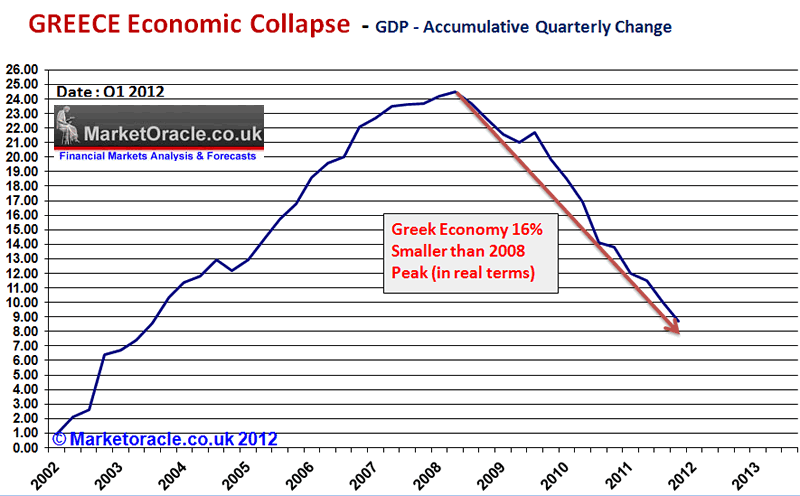
May 13, 2012 – GREECE – What may be lost in the noise that is the mainstream press is the fact that Greece has not been in a recession or even a depression, Greece has been in a state of slow motion economic collapse on the scale of past economic collapses such as that of Argentina but so far without the ability to default, devalue and inflate. As the below graph illustrates that following the financial crisis of 2008, Greece had been following a similar economic trend trajectory to that of most western economies including that of the UK, US and Germany, however the real crisis began in late 2009 when the economic recovery from the pit of the Great Recession of 2008-2009 evaporated and the Greek economy began a slow motion collapse that has so far seen Greek GDP in real terms contract by 16% since the 2008 peak, with no end in sight Unlike the V shape of the more regular debt default economic collapses such as that of Argentina’s of 2001 and more recently Iceland. The reason for this is solely due to Greece’s membership of the eurozone which has prevented Greece from defaulting on its debts since early 2010 and engaging in a sharp currency devaluation as markets would have corrected for the fact that Greece cannot compete against other countries. However instead of getting a grip on approx Euro 300 billion of public debt at that time, the Euro-zone despite since a 50% stealth default on private debt has still increased Greece’s total public debt burden by a further Euro 280 billion of 2 scheduled bailouts to stand at a total of over 400 billion Euro’s, leaving Greece far more indebted than where it were in late 2009 when economic collapse began, which is made infinitely worse as a consequence of the fact that Greece’s ability to service this debt has fallen as a consequence of the economic contraction. Similarly Greece as member of the Euro-zone has NOT had the option of experiencing a severe competitive devaluation of its currency of as much as 50% which would have instantly turned Greece’s trade imbalances around as Greece would no longer be importing goods and services from Germany that it could not afford as well as what little it does manufacture would have become far more attractive to export markets and especially its large tourism sector, which in fact as a consequence of a drop in demand suffered an increase in prices as a consequence of fixed euro costs’ which resulted in further reduction in demand and hence Greece has been in an economic death spiral. The situation has now reached a critical point (though it has been at a critical point for a good 18 months now) where in my opinion Greece now has no alternative but to exit the Euro-zone (not European Union) and it will exit the Euro-zone sooner rather than later i.e. I would be surprised if Greece is still in the Euro-zone by the end of this year and most probable expect Greece to exit during the next few months (Summer 2012). Greece exiting the Euro-zone would crash the banking system as banks across the euro-zone start to fail domino style as a consequence of their direct exposure to 400 billion of Greek debt and counterparty risks which will put immediate pressure on all of the other weak Euro-zone members, with Spain and Portugal the next targets for exit as a consequence of these countries being on the same unserviceable debt fuelled economic collapse trajectories as Greece. In my opinion Spain and Portugal will both exit the Euro-zone within 6 months of Greece leaving so depending on the timing of Greece’s exit Spain and Portugal could also both leave the the eurozone this year. –Market Oracle 
Leaders fear where Greece is headed: Speaking exclusively to The Sunday Telegraph, Theodoros Pangalos said he was “very much afraid of what is going to happen” after Greek voters rejected the deal in elections last Sunday. “In the places where the police voted, the fascists got 25 per cent,” he said. “They are a serious threat. They have used violence already – you don’t know where it will stop. “You know how it happened in Germany – it started with the Jews, then the Communists, then everybody – it could happen here. This is the country, after the Soviet Union and Germany itself, with the biggest percentage of [Second World War] casualties in its population.We will be in wild bankruptcy, out-of-control bankruptcy. The state will not be able to pay salaries and pensions. This is not recognized by the citizens. We have got until June before we run out of money.  -Telegraph 
Government talks turn uglyGreek politicians traded insults and accusations Sunday following an effort by President Karolos Papoulias to broker a coalition government, increasing the possibility of new elections in the debt-stricken country. Papoulias called together the leaders of the three biggest parties on Sunday, a week after indecisive elections and three failed attempts to form a government. A default by Greece could drag down other troubled governments such as Spain and Portugal. Europe is keeping a nervous eye on Greece, fearing that the political chaos there could lead to defaults on debt that could threaten the future of the euro. Greek failure — or refusal — to make debt payments could hurt banks across Europe. The eurozone economy is fragile, and any financial shock could plunge the region into a deep recession, a development that would ripple across the globe. A default by Greece also could drag down other troubled governments such as Spain and Portugal.  -CNN

Friday, May 11, 2012

Economic Collapse News Update - May 11, 2012

Economic Collapse News Update - May 11, 2012 / Jamie Dimon and other banksters


  • Video Transcript below

Headline Economic News for May 11, 2012 – Links to all reports are in the description for those who want to read the full stories. The transcript of this presentation will be on my blog at http://Apocalyspe2010.blogspot.ca. There is an excellent video link below that explains what GDP really means and how it’s calculated. It’s an eye-opener video, about 30 minutes long, I would recommend all to watch it carefully, very educational. I have included a 30 second clip out of this video in this update.

Let’s begin this report on Greece from www.ZeroHedge.com   

·       Schauble Says Europe Can Handle Greek Exit As EFSF, Fitch Warn Of "Catastrophe", Mass Downgrades:

Thursday, May 10, 2012

Greece: A Programmed Crisis?

From Russia Today

Political parties in Greece are struggling to come up with a power-sharing coalition deal, sending the crisis-hit country into further turmoil. General elections on Sunday failed to produce an outright winner, with leading parties so far failing to form a government. Without an agreement, fresh elections would have to be held. On Thursday, Athens is due to receive 5.2 billion euros in bailout funds but several eurozone countries were reluctant to forward this money because of the political instability. As part of the bailout terms, Athens must pass 14.5 billion euros worth of austerity measures in June. But financial chaos has led to public mistrust of pro-austerity parties. For more on this, RT talks to economic analyst, Michael Mross.

RT on Facebook: http://www.facebook.com/RTnews
RT on Twitter: http://twitter.com/RT_com


Damascus, Syria becoming a ruinous heap?

Syrian Crisis exacerbated by UN


Blogman's Notes:


Isaiah 17:1 The burden of Damascus. Behold, Damascus is taken away from being a city, and it shall be a ruinous heap.


Not that this is something we wish upon any people or any city, yet it has been prophesied that Damascus, the oldest continuously inhabited city in the world, will one day become a ruinous heap. Are we heading towards those days? Revolutions do not materialize out of nowhere; they require organization, money and weapons, all of which the so-called Syrian rebels seem to have in abundance. Like Libya, this revolution is not of the people but fomented  by powers that lie far beyond Syria's borders. Therefore it is highly unlikely that this 'Revolt' will dissipate and Syria will go back to being a relatively stable country. Like Afghanistan, Iraq, and Libya, what awaits Syria is much more destruction than the Syrian people could ever have imagined. It is a tragedy of immense proportions but only one of many more that will afflict the world in coming months and years. 

Luke 21:9 But when ye shall hear of wars and commotions, be not terrified: for these things must first come to pass; but the end is not by and by.
Luke 21:10Then said he unto them, Nation shall rise against nation, and kingdom against kingdom:
Luke 21:11 And great earthquakes shall be in divers places, and famines, and pestilences; and fearful sights and great signs shall there be from heaven.
__________________________________________________________
Residents and security personnel gather at the site of an explosion in Damascus May 10, 2012. Two explosions shook the Syrian capital Damascus on Thursday killing and wounding dozens of people, state media said, in a district that houses a military intelligence complex involved in President Bashar al-Assad's crackdown on a 14-month uprising. REUTERS-Khaled al-Hariri (SYRIA - Tags: CIVIL UNREST POLITICS)

(Reuters) - Two bomb explosions killed 40 people and wounded 170 in Damascus on Thursday, state media said, incinerating people in their cars and damaging an intelligence complex involved in President Bashar al-Assad's crackdown on a 14-month-old uprising.

The bombings, the deadliest in the Syrian capital since the revolt began, further shredded a ceasefire which was declared by international mediator Kofi Annan on April 12, but which has failed to halt bloodshed pitting Assad's security forces against peaceful demonstrators and an array of armed insurgents.

Opposition leaders said Annan's peace plan was dead and that the government had systematically sabotaged it.

Syrian television blamed "terrorists" for the morning rush-hour blasts. It showed mangled, smoldering vehicles, some with charred remains of their occupants inside.

The near-simultaneous explosions hit the al-Qazaz district just before 8 a.m. (0500 GMT), residents said. One punched a crater three meters (10 feet) deep in the city's southern ring road. Bloodied corpses and body parts could be seen on the road.

Tuesday, May 8, 2012

Hillary Clinton in India to pressure India to accept Iran Sanctions


Hillary Clinton is visiting India in the hope of persuading the country to halt oil imports from Iran or face sanctions itself. RT discussed the subject with Neil Padukone, an expert in geopolitics at the Takshashila Institute.
RT: The US and other Western nations have been ramping up pressure on the Iranian nuclear program for a long time now. But why bring India into it?
Neil Padukone: For the last five or ten years or so, India and Indian companies have been increasing their presence in the Iranian energy sector. So much so that a number of Indian oil refineries are specifically designed to refine Iran’s particular blend of crude oil and so as a result of this engagement, India’s become, along with China, one of the largest investors in Iran’s energy sector and one of its largest importers of crude oil. So if there’s going to be any dent to Iran’s energy sector, it’s going to have to involve countries like India and China and others that invest heavily in it.    
RT: What will it mean for India if the US does, in fact, hit New Delhi with sanctions?
NP: I’m not sure if New Delhi itself would be directly hit, but its energy companies would certainly be directly sanctioned. But the challenge is that it wouldn’t be all that easy to switch from Iranian crude to other sources, in part because the refineries in India are particularly geared to refine Iranian crude and it would take a pretty difficult and extensive retrofitting process to be able to do that. But at the same time it’s not just a matter of energy dependence because Pakistan has not allowed India to access Afghanistan through its borders across its territory. India has been forced to look a little further abroad. So it developed a very strategic link between the Chabahar Port in eastern Iran on the Gulf of Oman and western Afghanistan. And this road not only takes away Pakistan’s monopoly on Afghanistan’s maritime trade, but it also gives India some very strategic import access to Afghanistan and to central Asia in general. So sanctions would be a little more complicated than just withdrawing from the energy sector. 
RT: What is India’s stance on Tehran now?
NP: India has been facing a dilemma because it depends on Iran not only for energy and other trade, but also for strategic access to Central Asia and for other strategic ties. So on one hand it can’t entirely drop Iran, also for fear that if it drops Iran, China would pick up the pieces, especially in preferential financial terms. But at the same time, it can’t entirely reject the United States’ position because India is, of course, America’s burgeoning strategic ally. They have tremendous amounts of trade, they share strategic interests elsewhere in the world. So for the last five years and continuing, India has been trying to balance and juggle its relations between Iran and the United States. 
RT: What is India’s alternative if it does stop buying oil from Iran?
NP: As it’s been doing over the last few years, it’s been looking for creative means to engage with Iran economically. That involves creating new corporate entities that are outside of the realm of Western financial sanctions and even buying Iranian crude through rupees or with gold and other goods. So it’s sort of reverted to a barter system. So that’s one method of continuing to engage with Iran economically. 
India buys almost 80 per cent of Iranian crude, but has vowed to curtail its import of Iranian oil by 20 per cent, officials reported. For India, Iranian oil imports currently make up approximately 10 per cent of total oil imports, but that number is set to fall to seven per cent next year.

Monday, May 7, 2012

The Rapture: Fact or Fiction Part 2

Just because something is commonly accepted as truth does not make it the truth. In today's church this is certainly the case with the doctrine of the secret Rapture. It is commonly taught and accepted as the truth but is it? Today I will look at the few verses of scripture that are the basis of the doctrine of the Rapture, 1 Thes. 4:16and 17, and 1 Cor. 15:51 and 52. These four verses of scripture are at the very heart of the secret Rapture doctrine and if it can be proven that these verses, when taken in context, mean something completely different, then the truth will become apparent that the Rapture doctrine is a doctrine of devils not that of God. All Rapture teaching I have encountered takes 1 Thes. 4:16-17 out of context. Without understanding the context it is easy to formulate any doctrine and claim it is Biblical. The context of 1 Thes. 4:13-18 is the fate of the DEAD in Christ not that of the living. Yet this passage is invariably taught as concerning the living! It is about the Resurrection of the dead...What verses 16 and 17 teach is the Time (WHEN) and the Place (WHERE) of the Resurrection of all believers whether they are dead or alive. 1 Cor. 15 teaches the HOW of the Resurrection of the believers' bodies. If we can understand that these passages of Scripture teach the fulfillment of God's Promise of Eternal life to all who believe, then it becomes clear that they have nothing whatsoever to do with the fictional event called The Rapture. What 1 Thes. 4 and 1 Cor. 15 really teach is the Gospel of Jesus and expound on the Great Hope of all believers, that of Resurrection, even though our bodies may have died. These chapters provide details on the following aspects of the RESURRECTION of all Believers, Living and Dead:

  1. The TIME of the Resurrection - WHEN will it happen?
  2. The PLACE of the Resurrection - WHERE will it happen?
  3. The PROCESS of the Resurrection - HOW will it happen?


GM (Government Motors) loses billions while reporting profits

Blogman's Notes:


GMAC, General Motors' finance division was bailed out to the tune of billions just three years ago, along with GM and Chrysler. Renamed Ally Financial, this financing arm was used once again to practically give away GM and Chrysler cars with no interest financing. All of this came from the largesse of the Governments of the US and Canada, and the resulting bill has been sent to the taxpayers, as has become the norm as a result of the Financial Crisis. Bailouts are nothing more than money taken out of the pockets of taxpayers, even if the bill will come due in the future, and handed over to mega wealthy corporations, or more appropriately to the top Executives of these corporations, who pay themselves millions while bankrupting the bailed out corporation so it can come right back begging for more handouts. This seems to be the case with that which was formerly GMAC and is now ALLY Financial. Ally is once again teetering on the brink of bankruptcy as GMAC was only 3 years ago.
_____________________________________________________________
(Reuters) - In the fall of 2009, the board of GMAC, one of the largest U.S. auto and home-loan companies, gathered in New York to discuss whether to put its troubled mortgage unit into bankruptcy.
GMAC, now called Ally Financial, was just about to receive the last of $17 billion in taxpayer bailouts. The board, including directors named by the government, discussed whether to use bankruptcy to get rid of toxic mortgage assets that were pulling down the rest of the company, according to people who attended the meeting.
Alvaro de Molina, GMAC's CEO at the time, disagreed. The move, he said, would lead to years of fights with creditors and tough treatment from regulators that would hurt the company. De Molina prevailed, but the board lost confidence in the CEO and replaced him soon after with Michael Carpenter, an Ally director and former Citigroup Inc executive, these sources said.
Today, Residential Capital (ResCap) - Ally's mortgage servicing and lending unit that turned from being a profit engine to a lemon - is again on the verge of being put into bankruptcy, possibly within a week, according to sources with direct knowledge of the situation.

Saturday, May 5, 2012

Egypt erupting in violence


Egypt’s ruling military council has arrested 300 people and introduced an overnight curfew for the second night in a row following violent clashes in Cairo. Meanwhile, public anger has overflowed from Cairo into the city of Suez.
Military prosecutors say 300 demonstrators, including nine journalists, will be held for 15 days pending investigation into the clashes in the Abbasiya district on Friday.
After hours of questioning, the arrested were charged with assaulting army officers, assembling in a military zone and preventing members of the security forces from carrying out their work. The accused denied all charges.
The clashes erupted on Friday during an anti-military demonstration in Cairo’s Abbasiya district and resulted in one death and almost 400 injured. 
The military government has deployed extra troops in Cairo to try and curtail any spread in the violence that has gripped the city over the last week. An overnight curfew has also been introduced for a second consecutive night in the area surrounding the Defense Ministry.
Following the clashes in Cairo, a similar anti-military demonstration in Suez attempted to storm the governor’s office late on Friday.
Eyewitnesses say violence erupted in the center of the port city when anti-military protesters began to pelt the local governor’s building with stones. The subsequent skirmishes between police and activists led to the seven arrests.

Islamists join fray


Wednesday, May 2, 2012

Arab Spring in Egypt - Egyptians still waiting for democracy!

Blogman's Notes:

The much touted Arab Spring Revolution in Egypt has not brought Democracy to Egypt as the Western Media had forecast. It seems that Egypt will follow in the footsteps of Libya and Syria with a civil war and a much more brutal regime to follow that will replace the one that has been supposedly overthrown. Even with Hosni Mubarak gone, the military is very much in control of Egypt. A more appropriate term to describe the events of the past year in North Africa, and the Middle East, might be 'The Arab Winter' rather than the Arab Spring. Terrible times are in store for this region and I pray that it will not lead to more devastating wars and civil wars than have already been experienced in the region. World War 3 would not be out of the question if Iran is attacked. 
_______________________________________________________________


A protester protects a detained 'thug' from other protesters who wants to beat him during clashes between Islamist protesters and armed 'thugs' after an attack on protesters late Tuesday night, in Cairo May 2, 2012. REUTERS -Asmaa Waguih
(Reuters) - Egypt's army said on Wednesday it was deploying extra troops to control clashes that erupted at a protest near the Defence Ministry in Cairo, where medical and security sources said the death toll had risen to 11.
"Eight armored personnel carriers from the military central zone entered the Abassiya area to disperse the fighting between protesters, and not to disperse the peaceful demonstrators. However, protesters attacked the armed forces. The armed forces have orders to hold their ground," an army statement said.
The army said clashes had been contained. A Reuters witness said the situation on the ground had calmed.
(Reporting by Sherine El Madany and Marwa Awad; Writing by Edmund Blair; Editing by Janet Lawrence)

Tuesday, May 1, 2012

Economic Recovery is here - maybe not!

Blogman's Notes:


After months of propaganda in the mainstream media that the US Economy was in a state of recovery, reports are now leaking out that maybe it ain't so. As we have contended all along there is no Economic Recovery, neither will there be a recovery. The unprecedented magnitude of this crisis ensures that it will end only with a complete Global Economic Collapse. All the actions being taken by the 'authorities' ensure that this will indeed be the end result of that which we transpiring today in the Economic / Political realm. Until that collapse finally materializes, there will be a lot of grandstanding and a lot of  jaw-boning by politicians that we have entered a wonderful recovery. As they have been wrong all along, they will be proven wrong in the future. They know it, do you?
________________________________________________________________


(Reuters) - The U.S. economy appeared to downshift as it entered the second quarter, with consumers increasing their spending only modestly last month and a gauge of business activity in the Midwest falling sharply in April. 

Consumer spending rose 0.1 percent in March from a month earlier when taking inflation into account, the Commerce Department said on Monday.
Separately, a report from the private Institute for Supply Management-Chicago showed business cooled much more than expected in the Midwest during April.
"The economy is losing a little momentum," said Gary Thayer, a macro strategist at Wells Fargo Advisors in St. Louis.
The U.S. recovery had already slowed substantially in the first quarter as businesses cut back on investment and restocked shelves at a slower pace, data on Friday showed. Gross domestic product expanded at a 2.2 percent annual rate in the first three months of the year compared to 3 percent in the fourth quarter.