Protesters accuse President Morsi of imposing a new form of authoritarianism
Egyptian protesters have clashed with riot police outside the presidential palace in Cairo at a rally marking two years since Hosni Mubarak was ousted.
The police fired tear gas and water cannon to disperse the demonstrators who were throwing stones. Opposition groups accuse current Islamist President Mohammed Morsi of betraying the goals of revolution. Mr Morsi's supporters say the protesters want to bring down Egypt's first democratically elected leader. Hosni Mubarak - who had ruled the country's for almost 30 years - was swept from power in a wave of mass protests on 11 February 2011.
Canada kills controversial internet surveillance bill — RT
The Conservative Canadian government is abandoning its much-criticized internet surveillance bill, which would have allowed the government to keep tabs on its citizens and was disguised under the cloak of fighting child pornographers.
Justice Minister Rob Nicholson announced that Bill C-30, which caused public ire over privacy, is dead. “We’ve listened to the concerns of Canadians,” Nicholson told reporters. “We will not be proceeding with Bill C-30 … including the warrantless mandatory disclosure of basic subscriber information, or the requirement for telecommunications service providers to build intercept capabilities within their systems”.
Bill C-30 or otherwise known as the Protecting Children from Internet Predators Act was introduced in Parliament less than a year ago, and it was presented as a choice that Canadians must make: to either support the bill or be on the side of child pornographers. "He can either stand with us or stand with the child pornographers," argued Public Safety Minister Vic Toews in Parliament while attacking the opposition last February.
This comment led to public outrage, raising privacy concerns across the nation.
What made the legislation dangerous was that it forced Internet service providers to have systems that allowed police to intercept and track online communications.
Also, it would have permitted authorities to have warrantless access to Internet subscriber information, including name, address, telephone number, email address and Internet protocol address.
But, activists viewed the proposed bill as a huge infringement on privacy. “This is a great day,” critic of the bill, Ontario Privacy Commissioner Ann Couvukian told The Globe and Mail, “This is a victory for privacy and for freedom.”
International hacktivist movement Anonymous also hailed the killing of the bill.
Read More: Canada kills controversial internet surveillance bill — RT
http://usawatchdog.com/biggest-bubble... When it comes to recent revelations about the extensive use of drones to kill terrorists, both foreign and domestic, Dr. Paul Craig Roberts says, "It's not just unconstitutional, murder is illegal." When it comes to drone strikes on U.S. citizens suspected of terror, everyone should be concerned. Roberts says, "Now the principle is if the government says you are guilty, you are—period. No evidence is needed for your termination." Join Greg Hunter as he goes One-on-One with Dr. Paul Craig Roberts.
Pope Benedict XVI is to resign for reasons relating to his health, according to a Vatican spokesperson. He's the first head of the Catholic Church to quit the highest post since the Middle Ages. The 85-year-old is due to step down on February 28. The Pope said he is “fully aware of the gravity of this gesture” but that he lacks the strength to govern Church due to age, according to Vatican's spokesperson Federico Lombardi.
In a statement released by the Catholic Church, Benedict VXI said that “after having repeatedly examined my conscience before God, I have come to the certainty that my strengths, due to an advanced age, are no longer suited to an adequate exercise of the Petrine ministry.”
1 Timothy 6:9-10But they that will be rich fall into temptation and a snare, and into many foolish and hurtful lusts, which drown men in destruction and perdition. 10 For the love of money is the root of all evil: which while some coveted after, they have erred from the faith, and pierced themselves through with many sorrows. Revelation 18:11-1311 And the merchants of the earth shall weep and mourn over her; for no man buyeth their merchandise any more: 12 The merchandise of gold, and silver, and precious stones, and of pearls, and fine linen, and purple, and silk, and scarlet, and all thyine wood, and all manner vessels of ivory, and all manner vessels of most precious wood, and of brass, and iron, and marble, 13 And cinnamon, and odours, and ointments, and frankincense, and wine, and oil, and fine flour, and wheat, and beasts, and sheep, and horses, and chariots, and slaves (BODIES), and souls of men. ________________________________________________________________________________
THE Chinese new year, which this year falls on February 10th, is a time of family reunions. But Xiao Chaohua is preparing to spend his sixth new year without his son, who was abducted in 2007 by suspected child traffickers. China’s one-child policy has fuelled demand for children like his, thousands of whom are snatched and sold every year to desperate, usually boy-less, couples. Spurred by the campaigning of parents like Mr Xiao, the government is starting to acknowledge the practice more openly. But curbing it is proving tough.
Mr Xiao has been trying the hard way to raise awareness of the crime; driving around the country in a minivan covered with posters of missing children. One of them features his son, then five years old, dressed up for a school photograph in a white jacket with red lapels (see picture). Mr Xiao, who lives in a village near Tongzhou, one of Beijing’s satellite towns, says he has spent as much as 400,000 yuan ($64,300) of his own money on the project. He says there are other parents elsewhere in China who tour the country in similarly bedecked vehicles.
By Stephanie Stahl PHILADELPHIA (CBS) – It’s a mysterious, newly discovered disease that strikes mainly young women, and it’s often misdiagnosed. Doctors who discovered it, here in Philadelphia, say it’s like your brain is on fire. 3 On Your Side Health Reporter Stephanie Stahl says it starts with personality changes.
Young women dazed, restrained in hospital beds, acting possessed and then becoming catatonic. They’d been so normal, when suddenly their lives went haywire.
“One minute I’d be sobbing, crying hysterically, and the next minute I’d be laughing, said Susannah Cahalan, of New Jersey.
“I was very paranoid and manic. There was something wrong. I thought trucks were following me,” said Emily Gavigan, of Pennsylvania.
And it got worse for Emily Gavigan, who was a sophomore at the University of Scranton. Hospitalized, and out of it, she couldn’t control her arm movements. Then there were seizures, and she needed a ventilator. Her parents were watching their only child slip away.
“It was life and death for weeks,” said Grace Gavigan, Emily’s mom.
“We were losing her. This is something that I couldn’t control,” said Bill Gavigan, Emily’s dad.
Doctors also couldn’t figure out what was wrong with Susannah.
“I had bizarre abnormal movements, would leave my arms out extended, you know, in front of me. I was a relatively normal person, then the next minute I’m hallucinating and insisting that my father had kidnapped me,” said Susannah.
SRINAGAR, India (AP) — Most of Indian-controlled Kashmir was paralyzed Sunday as a strict curfew imposed after the execution of a Kashmiri man convicted in a deadly 2001 attack on India's Parliament remained in effect.
Mohammed Afzal Guru was hanged in New Delhi early Saturday. Ahead of the execution, authorities ordered people in most of the Indian-held part of the disputed Kashmir region to remain indoors indefinitely in anticipation of anti-India protests.
On Sunday, scores of people defied the curfew and clashed with troops who fired tear gas shells to disperse the crowds, a police officer said on customary condition of anonymity. Four policemen were injured in the clashes, he said. Police said 23 troops and 13 protesters were injured in demonstrations on Saturday.
Tens of thousands of security troops were fanned out across the Himalayan region, and metal barricades and razor wire blocked all major roads in the area.
CARACAS, Venezuela (AP) — Venezuela's government announced Friday that it is devaluing the country's currency, a long-anticipated change expected to push up prices in the heavily import-reliant economy. Officials said the fixed exchange rate is changing from 4.30 bolivars to the dollar to 6.30 bolivars to the dollar. The devaluation had been widely expected by analysts in recent months, though experts had been unsure about whether the government would act while President Hugo Chavez remained out of sight in Cuba recovering from cancer surgery. It was the first devaluation to be announced by Chavez's government since 2010, and it pushed up the price of the dollar against the bolivar by 46.5 percent. By boosting the bolivar value of Venezuela's dollar-denominated oil sales, the change is expected to help ease a difficult budget outlook for the government, which has turned increasingly to borrowing to meet its spending obligations.
Travel Ban Lifted, But Blizzard Cleanup Continues Connecticut « CBS New York DANBURY, Conn. (CBSNewYork) — A travel ban was lifted in Connecticut after 24 hours of orders to stay off the roads, but cleanup was far from over Saturday following the blizzard that left at least five people dead, and more than 3 feet of snow in some parts of the state.
On Saturday night, Gov. Dannel Malloy submitted a request for a presidential emergency declaration. “As we continue with the recovery from this historic winter storm, I am asking the federal government to provide us assistance with this process,” Malloy said. ”If granted, this declaration would provide much needed help to our state.”
Cars were buried by the blizzard in Danbury, Conn. (Credit: CBS 2)
“Stay off the roads,” is still the message in the Nutmeg State. Parts of Connecticut were covered in dozens of inches of snow early Saturday, as a travel ban remained in effect until being lifted at 4 p.m. A state of emergency remains in effect statewide. A woman using a snowblower Friday evening was apparently hit by a car and killed in Prospect, Malloy said. The woman was believed to be 81 years old, but her identity was not released. Also, a 73-year-old man was found dead of unknown causes in his driveway in Danbury, and a 49-year-old man apparently died while digging out his truck in Shelton and had to be taken away on a sled pulled by a snowmobile, according to a Hartford Courant report. No information was immediately released on the other two deaths. At a news conference late Saturday morning, Gov. Malloy said 270 National Guard troops were pressed into duty to assist with the blizzard aftermath. There are many roads that are impassable or otherwise dangerous due to snow drifts or stalled cars, Malloy said.play
Film Presented by John Massaria. The audio is part of a teleconference call between Russ Tanner (Global Skywatch) and Dane Wigington (WIWATS/Activist) These calls happen every Monday at 7 : 30 central time and can be accessed through Russ' fb page. Please join us!
Scientific Research explaining why they are spraying the sky's around the world. Learn and more importantly do something about the Chem trails being sprayed. Learn the details here in this short film. UN Environment Programme: 200 Species Extinct Every Day, Unlike Anything Since Dinosaurs Disappeared 65 Million Years Ago. According to the UN Environment Programme, the Earth is in the midst of a mass extinction of life. Scientists estimate that 150-200 species of plant, insect, bird and mammal become extinct every 24 hours. This is nearly 1,000 times the "natural" or "background" rate and, say many biologists, is greater than anything the world has experienced since the vanishing of the dinosaurs nearly 65m years ago.
I had to turn off comments because to many people (dis-informed people) were saying they don't seed or spray the sky's, and well... all I have to do is look up or look at the documents I have to show these are plain ignorant to facts and data. Maybe they are in denial.
A potentially record-breaking snow storm has brought the US northeast to a grinding halt and left one dead. Thousands lost power amid flight cancelations and a nuclear plant shutdown, as authorities declared an emergency situation in five states.
The blizzard, which has been dubbed ‘Nemo’, struck the west coast on Friday, dumping over 16 inches (40 cm) of snow in some areas. The storm clobbered New York during the night, leading to mass flight cancellations and the closure of roads, while across the northeast over 500,000 homes were left without power.
Read More: Massive blizzard paralyses US northeast, 1 dead (PHOTOS) — RT
February 8, 2013 – GREAT LAKES, US - Two of the Great Lakes have hit their lowest water levels ever recorded, the U.S. Army Corps of Engineers said Tuesday, capping more than a decade of below-normal rain and snowfall and higher temperatures that boost evaporation. Measurements taken last month show Lake Huron and Lake Michigan have reached their lowest ebb since record keeping began in 1918, and the lakes could set additional records over the next few months, the corps said. The lakes were 29 inches below their long-term average and had declined 17 inches since January 2012. The other Great Lakes — Superior, Erie and Ontario — were also well below average. “We’re in an extreme situation,” said Keith Kompoltowicz, watershed hydrology chief for the corps district office in Detroit. The low water has caused heavy economic losses by forcing cargo ships to carry lighter loads, leaving boat docks high and dry, and damaging fish-spawning areas. And vegetation has sprung up in newly exposed shoreline bottomlands, a turnoff for hotel customers who prefer sandy beaches. The corps’ report came as shippers pleaded with Congress for more money to dredge ever-shallower harbors and channels. Shippers are taxed to support a harbor maintenance fund, but only about half of the revenue is spent on dredging. The remainder is diverted to the treasury for other purposes. Legislation to change that policy is pending before Congress. “Plunging water levels are beyond anyone’s control, but the dredging crisis is man-made,” said James Weakley, president of the Cleveland-based Lake Carriers’ Association. Kompoltowicz said the Army corps might reconsider a long-debated proposal to place structures in a river to reduce the flow of water away from Lakes Huron and Lake Michigan, which are connected. Scientists say lake levels are cyclical and controlled mostly by nature. They began a steep decline in the late 1990s and have usually lagged well below their historical averages since then. But studies have shown that Huron and Michigan fell by 10 to 16 inches because of dredging over the years to deepen the navigational channel in the St. Clair River, most recently in the 1960s. Dredging of the river, which is on the south end of Lake Huron, accelerated the flow of water southward from the two lakes toward Lake Erie and Lake Ontario, and eventually into the Atlantic Ocean. Groups representing shoreline property owners, primarily in Lake Huron’s Georgian Bay, have demanded action to slow the Lake Huron and Michigan outflow to make up for losses that resulted from dredging, which they contend are even greater than officials have acknowledged. Although the Army corps produced a list of water-slowing options in 1972, including miniature dams and sills that resemble speed bumps along the river bottom, nothing was done because the lakes were in a period of above-average levels that lasted nearly three decades, Kompoltowicz said. The corps has congressional authorization to take action but would need money for an updated study as a first step, he said. The Detroit office is considering a funding request, but it would have to compete with other projects nationwide and couldn’t get into the budget before 2015. “It’s no guarantee that we’re going to get it, especially in this budget climate,” Kompoltowicz said. “But there are serious impacts to navigation and shoreline property owners from this extreme event. It’s time to revisit this.” Roger Gauthier, a retired staff hydrologist with the Army corps, said a series of “speed bumps” could be put in the river at a reasonable cost within a few years. Without such measures, he warned, “it would take years of consistent rain” to return Lake Michigan and Lake Huron to normal. –Yahoo News
This handout picture, taken by Tokyo Electric Power Co (TEPCO) on March 18, 2011 and released on February 1, 2013 shows water discharged against unit 3 reactor building at the Fukushima Dai-ichi nuclear plant at Okuma town in Fukushima prefecture. (AFP Photo/TEPCO)
At least 350 people affected by the 2011 Fukushima nuclear meltdown will file a class action lawsuit against the Japanese government and the plant’s operator, Tokyo Electric Power Co (TEPCO) on the second anniversary of the disaster.
Lawyers representing residents whose homes and farms were hit by radiation in the wake of the disaster said it was the largest suit on the issue filed against the government.
The plaintiffs will further seek some US$535 each in compensation from TEPCO for every month they have been displaced as a result of the accident.
They also plan to seek a court injunction that will require both the government and TEPCO to reduce radiation levels in the affected area to pre-disaster levels.
The suit will be filed on March 11, the two-year anniversary of the world’s worst nuclear accident since the 1986 Chernobyl disaster. Several other similar class-action suits against both the government and TEPCO will be filed with the Tokyo District Court on the same day. "The government promoted nuclear power as a national policy and has been closely involved with it," lawyer Izutaro Managi told AAP news agency. "Being fully aware of the danger of losing power due to a tsunami, the government neglected its duty to prevent such an event," he said. "This is a suit to recover a Fukushima with neither radiation nor nuclear power," he continued.
The Fukushima Daiichi nuclear disaster occurred after a 9.0-magnitude earthquake and a subsequent tsunami crashed into the power station and knocked out its cooling system leading to the meltdown of three reactor cores. Tens of thousands were forced to flee the area and many are still unable to return.
February 8, 2013 — Drivers across southern Ontario are urged to take precautions before heading out this morning as a powerful winter storm strikes the region.The snow's already piled on in some areas of Ontario (Courtesy Malou Meirsman)
Tune into The Weather Network on TV for continued live coverage of the storm.
It will be very messy through most of southern Ontario Friday, as an Alberta clipper, combined with moisture from a Texas low makes it way into the province. As of 7 a.m. Pearson Airport had already seen 9 centimetres of snow while in Markham it reached 11.
A Winter Storm Warning is currently in effect for an area stretching from St. Catharines to Mississauga.
The low pressure system is expected to drop up to 35 cm in some parts of the province while the GTA could see closer to 28.
A 7.1 magnitude earthquake has struck just off the Solomon Islands in the Pacific Ocean. No immediate reports of casualties or damages are available at the moment.
The epicenter of the quake was at a depth of 9km, the US Geological Survey said. The Pacific Tsunami Warning Center reported no tsunami warning was issued.
It comes just one day after the islands were shaken by an 8.0-magnitude quake producing numerous aftershocks of between 4 and 5 magnitude. Five people were confirmed dead in that disaster, two of them children.
An 8.0-magnitude earthquake struck the Solomon Islands in the South Pacific on Wednesday. At least five people died as the disaster reportedly flattened several coastal villages.
Jim Rogers of Rogers International Commodities Index (RICI) joins Open Currency Update with Kurt Wallace for Fed Easing? ‘This is going to end very very badly’. Jim discusses Germany’s repatriation of gold and the questionable response of and 8 year timeline by the United States to return the gold. He weighs in on Fed Easing and the effects on those who invested properly vs. those who benefit from printing money. He also give us a sneak preview of his new book Street Smarts: Adventures on the Road and in the Markets where he details his thought process on investing and what he learned from his successes and mistakes.
Jim Rogers, a native of Demopolis, Alabama, is an author, financial commentator and successful international investor. He has been frequently featured in Time, The Washington Post, The New York Times, Barron’s, Forbes, Fortune, The Wall Street Journal, The Financial Times, and most publications dealing with the economy or finance
UK officials plan to monitor Britons' online activities by placing surveillance devices on the country's telecom networks, a Parliamentary report says. The program would keep tabs on which websites were visited as well as who contacted whom.
On Tuesday the British Parliament's Intelligence and Security Committee published the report outlining a massive, national surveillance program based in the country's very electronic infrastructure. The report does not specify the number of so-called "probes" to be installed across Britain's telecommunications networks, but says it would be part of a regime stockpiling information on nearly every move Britons make online. “It’s been in the media and on the table of the government since last April and it’s been receiving quite a lot of attention, as you can imagine the people in Great Britain don’t like the thought of the government collecting all of their communications in this way. From their point of view, it goes against the very basis of the democratic institution that is our parliament in Britain,” deputy director of Big Brother Watch, Emma Carr, told RT.
The new program will go beyond just keeping tabs on the Brits. If anyone abroad communicates online with someone in the UK then it will allow surveillance of their personal information as well, stretching the program’s geographical reach.
The government says the installation of the probes will be critical in the online fight against terrorism and other crime, and that the content of emails or Skype calls would not necessarily be collected. Instead, they say, the program would keep track of so-called "outside the envelope" information – such as a message's origin and recipient. An email’s contents would be accessible with a court order, though time and date of sending and receipt would be available with the authorization of a senior law enforcement or intelligence officer.
Which online services the probes would monitor were not identified in the report. However, Facebook, Twitter, Hotmail, and Google Chat are all widely used in the UK and are mentioned in other sections of the report.
However, people use encryption more and more during communicating with others on the web. It could significantly complicate the life of those, who will be trying to keep track of every word sent or received vie internet, believes Carr. “One of the things, that came out of the evidence when was being gathered for this bill is that encryption is a very widely used tool by people who communicate via internet. And actually that’s going to make the kind of inspection of the communications that we have very difficult for the government and the internet service providers, who are going to be asked to gather all of this information,” she added.
The report said the surveillance regime would function on deep packet inspection, a monitoring method that lets an individual who intercepts data to search its contents. Though the project is still in draft form, the committee generally rejected critics' claims that it would constitute an oppressive domestic spying program, saying that without such new security measures, rapidly developing technologies would soon "have a serious impact on the intelligence and security agencies."
"Under current European data retention laws, deep packet inspection is not only legal, but also widely used by the private sector," the report notes. "Whilst legislation is not a perfect solution," it states elsewhere, "we believe it is the best available option."
‘Orwellian state’
Likening the new surveillance program to an Orwellian vision of the future, investigative journalist Tony Gosling told RT that the UK should “protect the people from this Big Brother state” rather than shutting them in an “electronic cage.” “There is great commercial pressure for this intrusion since much of this information can be sold quietly to rich corporations and commercial concerns. This is something the public cannot compete with, this lobbying power backed by commercial interests,” noted Gosling. He went on to say that this dark side to big business that “leads to a dictatorial fascist system similar to that in Nazi Germany.”
In the future, if the changes are implemented Gosling concluded that “people will think twice before emailing Orwellian Britain” and speculated that there could be a boost to the old-fashioned postal services.
The daily drumbeat of layoff and plant-closure announcements in France has been riling up desperate workers who stand to lose their livelihood without much hope of finding a job elsewhere as unemployment has hit 10.5%. But now the government is worried about a “radicalization” of these angry workers. A major quandary: on one hand, the Socialists promised during the election to side with the workers; but on the other hand, they must somehow figure out how to create an environment where the private sector can survive.
And the private sector is gasping for air. The Services Purchasing Managers’ Index fell to 43.6 in January, from 45.2 in December (below 50 = contraction), the fastest rate of contraction since March 2009. Particularly worrisome was the steep decline in employment. Manufacturing was even worse. Its index fell to 42.9 in January. New orders plunged at the fastest rate since March 2009, with domestic demand the primary culprit. Employment skidded as excess capacity led companies to slash their headcount.
That these references to March 2009, the dark days of the financial crisis, keep cropping up in economic data is troubling. The report speaks of a “deepening malaise” and “a broad-based deterioration in the private sector” with “significant headwinds,” “accelerated job cutting,” and “heightened levels of uncertainty.” President François Hollande and his government should be in panic mode.
The private sector is anemic in France. Based on the 2013 budget, the central government will contribute 56.3% to the economy. The remaining 43.7% is spread over local and regional governments and finally the private sector—that is shriveling with the relentless de-industrialization of France.
Read More: French Government Fears 'Social Implosions Or Explosions' | Zero Hedge
A fruit and vegetable handout in Greece led to one man being trampled on Wednesday, calling attention to the desperate conditions in the crisis-hit country. Some 55 tons of produce was given away by farmers who were protesting high production costs.
The person was injured when he was pushed by a crowd trying to grab the goods and fell and hit his head.
The chaos was sparked when food stalls ran out of fruits and vegetables, prompting dozens of people to rush to a nearby truck.
It was an “every man for himself” situation as the Greeks shoved their way to the front of the truck, competing for the food that was left. The 55 tons of food was completely gone in under two hours.
A Reuters employee at the scene was hit on the head with cauliflower heads as he attempted to photograph the situation.
People reach out for a bag of oranges during a free distribution of fruit and vegetables by Greek farmers outside the Agriculture Ministry in Athens part a farmers protest against high production costs, including petrol, on February 6, 2013. (AFP Photo / Louisa Gouliamaki)
Tunisian opposition leader Chokri Belaid has been shot dead outside his home, prompting thousands of Tunisians to protest in front of the Interior Ministry and in many others towns. Cries of “the government should fall” have been heard.
The streets in front of the Interior Ministry are now packed, according to eyewitness accounts. Security forces cordoned off the area. “Protesters are running around announcing that live ammunition has been used,” tweeted @myriambenghazi who is at the site.
The Islamist Ennahda party offices have been attacked and torched in several cities across the country. Further protests have erupted in several towns.
Thousands have flooded the streets in the Tunisian city of Sidi Bouzid alone. A local man placed the number protesting at “more than 4,000,” according to Reuters.He said that many were “burning tires and throwing stones at the police."
Ennahda came to power following the 2011 revolution and has been accused of seeking to monopolize power.
Chokri Belaid had recently formed a coalition in opposition against the Islamist-led government, leading Prime Minister Hamadi Jebali to condemn the suspected politically-motivated assassination. Jebali labeled his death “the assassination of the Tunisian revolution,” adding that, “by killing him they wanted to silence his voice.” Read More: Thousands protest after Tunisian top opposition leader shot dead (VIDEO, PHOTOS) — RT
People surround an ambulance transporting the body of Tunisian opposition leader and outspoken government critic Chokri Belaid on February 6, 2013. (AFP Photo / Feithi Belaid)
An 8.0-magnitude earthquake struck the Solomon Islands in the South Pacific on Wednesday. At least five people died as the disaster reportedly flattened several coastal villages.
Five people were confirmed dead in the disaster. They were two elderly men, two elderly women and a boy aged between 10 and 12, local medics said.
The epicenter of the tremor was located at a shallow depth of 5.8 km in the area of the Santa Cruz Islands, the US Geological Survey initially reported. It later revised it to a much greater depth of 28.7 km. The first tremor was followed shortly after by two strong aftershocks – one rated at magnitude 6.4 and another at 6.6 – and dozens smaller ones over the next few hours.
At least three villages along the Lata coast have been reported destroyed, Director of Nursing Augustine Bilve at Lata Hospital told New Zealand’s One News. He said up to 700 people lived in the affected villages and the hospital was expecting many casualties. “It's more likely that other villages along the coast of Santa Cruz would also be affected," Bilve added.
Read More: Solomon Islands hit by 8.0 quake and tsunami, at least 5 dead — RT
Map locating the epicentre of an 8.0 magnitude quake that struck off Solomon Islands.
The snowiest winter in a century has hit the Russian capital, causing Muscovites to get stuck in traffic jams 3,500km in length on Monday evening – the distance from Moscow to Madrid.
Since the beginning of the winter, over 2 meters of snow has fallen on the Russian capital, the Moscow mayor’s aide in housing and public utilities Pyotr Biryukov told Interfax. Snowfall is expected in Moscow for four or five more days, he added.
On Monday, 45,000 community services employees and 15,000 units of equipment were attempting to cope with 26 cm of snow – nearly a fifth of the average annual fall.
The latest snowfall has become a nightmare for drivers with the capital’s commuters trapped in gridlock.
Many of those who left their workplace in the evening had to spend five to 10 hours getting home. The average speed of vehicles was no more than 7-9 km/h. The number of road accidents – 3,000 – was much higher than during an ordinary day, with minor accidents quadrupling, according to Channel One TV.
French President Francois Hollande is triumphant about his operation in Mali, but stories are emerging which show a different side of the war. Journalist Gonzalo Wancho tells RT that for every two rebels killed in airstrikes, a dozen civilians died. “We’re learning what happened in battle day by day. In the town of Konna, we heard stories from the fog of war. [Rebels] fled to the north when French troops showed up. It’s reported that the cost of that victory was high. While French planes killed only two rebels, the number of civilian casualties were an estimated 14,” journalist Gonzalo Wancha told RT.
It comes just days after French President Francois Hollande declared “victory” in northern Malian cities. But the victory also had its price: “I wasn’t home when the bombing began. I started praying when I learned my house was under attack. They ruined everything I had – my family and my livelihood. [My children were 11, 10, and 6]. They all died,” Idrís Meiga, a farmer from Konna, told RT.
Meiga’s story is not unique. In fact, it is becoming all too common to hear of similar tragedies in northern Mali. “Some kids came running up to us and said their mom had died. I brought them to our house. Their mother died after an hour of clinging to life. The children have nobody else but us,” resident Abdul Kampó said.
Another story involved a mother who died from shell splinters, leaving three children behind – including a newborn baby.
Two young brothers drowned in a nearby river as they attempted to flee from the fighting.
These residents refuse to be persuaded by military claims of “victory.” “People [in the town] say [French] war crimes must be prosecuted under the Geneva Convention,” Wancha said.
And while Hollande maintains that French military intervention in Mali will be short lived, the consequences of this war will affect the lives of these innocent civilians for a lifetime.
Meanwhile, airstrikes continue in Mali’s far north. Earlier Monday, 30 jets targeted training and communication centers of Islamist militants in the town of Tessalit.
The move was an effort to cut off nearby supply routes. French Foreign Minister Laurent Fabius told France’s Inter radio that rebels “cannot stay there a long time unless they have new supplies.”
It is believed that French civilians are being held hostage by militants in the area.
Both France and the Malian government have come under criticism for their alleged activity against terrorists and Islamist supporters in the African country.
Days ago, three suspected Jihadists who were arrested in the liberation of Timbuktu said they were tortured by Malian soldiers who used a method similar to waterboarding. “To force me to talk they poured 40 liters of water in my mouth and over my nostrils, which made it so that I could not breathe anymore. For a moment I thought I was actually going to die,” said one of the men who said he was from the central Malian town of Niono.
According to a report by Human Rights Watch, Malian government forces executed at least 13 suspected Islamist supporters and “forcibly disappeared” five others from the towns of Sévaré and Konna last month.
Malian child soldiers are fighting in the country’s conflict, journalists on the ground have reported. While French troops have boasted of the successful retaking of northern Mali from Islamist fighters, sectarian violence is worsening.
Editors' Note: Isn't it amazing how the big bosses at Too Big to Fail banks and corporations are never charged with any criminal activity for defrauding their customers and the citizenry at large of billions through illegal activities. Their criminal acts are termed MIS-SELLING and SCANDALS by the Mainstream media rather than CRIMES and TREASONS that they are in fact. The CEO can steal billions and it's called a SCANDAL but if a lowly Teller at the same institution steals a thousand, she is immediately charged with criminal activity and the media reports it as THEFT not a SCANDAL. Reuters should be charged as accessories to the crimes of the bankers for covering up their frauds, thefts, treasons, and crimes against humanity with such innocuous sounding words and terms as SCANDALS and MIS-SELLING! What the heck is MIS-SELLING anyway? Someone accidentally sells a billion dollars worth of securities knowing full well they are worth only 200 million, and a buyer just accidentally buys them? See how the media makes fools out of their readers by using such asinine terms as MIS-SELLING to confuse the issue? But given the fact that the same bankers that commit these crimes own the Media (and the Government), such an outcome as the criminals actually getting charged with crimes is well nigh impossible!
(Reuters) - Barclays bosses ducked questions on Tuesday over funding for its rescue by Qatar four years ago, as another big charge for mis-selling showed how past problems continue to dog the British bank.
UK authorities have been investigating the bank's fundraising from Qatar at the height of the 2008 financial crisis since July. The Financial Times reported last week that they were looking into whether Barclays had lent Qatar money to buy shares in the bank itself.
Asked by UK lawmakers if there was anything linked to the Qatar fundraising that could cause embarrassment in the future, Barclays Chairman David Walker told a parliamentary inquiry that he could not comment due to the investigation.
Earlier, the bank said it had set aside a further 1 billion pounds ($1.6 billion), including an extra 600 million to compensate customers for payment protection insurance. PPI mis-selling alone has now cost UK banks over 12 billion and could end up more than double that, industry sources estimate.
Unlike RBS and Lloyds, which had to take government bailouts during the crisis, Barclays avoided a rescue funded by British taxpayers after Qatar bought its stake.
However, the wider banking industry has come under fire for a series of scandals including the mis-selling of financial products to clients who did not need or could not use them, and over the rigging of a major interest rate. This, along with public anger at big bonus payments, has put the spotlight on the culture of bankers before, during and since the crisis.
Once the world's second-largest colonial empire, France may be striving to regain influence in its former African colonies, the Mali operation being part of such policy. Many believe Mali as well as neighboring Niger are keys to France's energy security. And French President Hollande can't risk harm to his economy - because as RT's Maria Finoshina reports - there are increasing doubts about whether or not he can turn it around.
Israel will regret its attack against Syria, a top Iranian official has warned during a visit to Damascus. The remarks come as Israel is reportedly planning to set up a buffer zone along its border with Syria to guard against Islamist fighters.
The results of the attack would be bad for Israel, like those suffered during previous conflicts initiated by Tel Aviv, such as the 34-day war with Lebanese militant group Hezbollah in 2006, said Saeed Jalili, head of Iran’s National Security Council. "Today, too, both the people and the government of Syria are serious regarding the issue. And also the Islamic community is supporting Syria," Reuters quoted Jalili as saying.
The remarks came on Monday shortly after similar statements by Syria. Top Syrian officials, including President Bashar Assad, warned earlier that the Wednesday airstrike on a military research center in Jamraya, outside Damascus, would not go unanswered. The Israeli attack drew criticism not only from Syria’s key regional ally Iran, but also from its adversary Turkey. In a comment on the airstrike, Turkish Prime Minister Recep Tayyip Erdogan said on Sunday that "Israel has a mentality of waging state terrorism. Right now, there is no telling what it might do and where it might do it."
Syrian TV has broadcast images of what it said was the aftermath of an Israeli airstrike on a research facility near Damascus. Israel has implicitly admitted it was behind the raid, which allegedly targeted a weapons convoy headed to Lebanon.
Israel may strike at Syria again if it detects the movement of weaponry intended for Hezbollah, sources have told the media. The US has voiced support for any measures that prevent weapons from falling into the hands of the region's extremists.
Syria has filed an official complaint to the United Nations over an Israeli airstrike on a military research center near Damascus. The move followed a threat from Iran that Israel would face “serious consequences” for the attack. Syria unrestIsrael vs Iran
As the world's economic powers squabble over the intricacies of cause and effect in a vicious cycle of currency devaluation and domestic economic defense; it appears, NYTimes reports, that the US is leading the way in another direction. A secret legal review on the use of America’s growing arsenal of cyberweapons has concluded that President Obama has the broad power to order a pre-emptive strike if the United States detects credible evidence of a major digital attack looming from abroad - i.e. if we 'suspect' someone is going to hack us, we can hack them. In what appears to be Stuxnet's bigger (and scarier) brother,one official noted, "there are levels of cyberwarfare that are far more aggressive than anything that has been used or recommended to be done." New policies will also govern how the intelligence agencies can carry out searches of faraway computer networks for signs of potential attacks on the United States and, if the president approves, attack adversaries by injecting them with destructive code - even if there is no declared war. Cyberweaponry is the newest and perhaps most complex arms race under way, based in Cyber Command at The Pentagon, with the unspoken question being, ‘What are we going to do about China?’
Via NY Times,
A secret legal review on the use of America’s growing arsenal of cyberweapons has concluded that President Obama has the broad power to order a pre-emptive strike if the United States detects credible evidence of a major digital attack looming from abroad, according to officials involved in the review.
That decision is among several reached in recent months as the administration moves, in the next few weeks, to approve the nation’s first rules for how the military can defend, or retaliate, against a major cyberattack. New policies will also govern how the intelligence agencies can carry out searches of faraway computer networks for signs of potential attacks on the United States and, if the president approves, attack adversaries by injecting them with destructive code — even if there is no declared war.
... Cyberweaponry is the newest and perhaps most complex arms race under way. The Pentagon has created a new Cyber Command, and computer network warfare is one of the few parts of the military budget that is expected to grow.
... Mr. Obama is known to have approved the use of cyberweapons only once, early in his presidency, when he ordered an escalating series of cyberattacks against Iran’s nuclear enrichment facilities.
A 6.9-magnitude earthquake has hit the coast of Hokkaido, Japan, the US Geological Service reports. Two nuclear power plants are in the affected area.
The quake that occurred at 11:17 pm (14:17 GMT) was marked 5 upper at JMA Seismic Intensity in several places in Hokkaido.
According to the USGC, the epicenter of the earthquake was located at a depth of 120 kilometers.
The Japan Meteorological Agency (JMA) seismic intensity scale is used to measure earthquake strength in Japan and Taiwan and runs from 0 to 7. Starting in 1995, after the Great Hanshin earthquake, levels 5 and 6 are usually divided in ‘lower’ and ‘upper’ referring to ‘weak’ and ‘strong’.
Shaking could be felt near Hokkaido's capital Sapporo as well as in some regions of Tokyo, which is located down the island.
No tsunami warning has been issued, and no damage or injuries have been reported.
Local public broadcaster NHK said nearby nuclear plants, Tomari and Higashidori, were not observing any abnormalities.
Seismic activity in the region has increased in the past few days, and several smaller quakes have rattled the region.
Back in December a powerful 7.3-magnitude undersea quake off the northeast coast of Japan triggered a one-metre-high tsunami, but it caused no major damage.
One of the most devastating earthquakes and tsunamis in history hit Japan in March 2011 when 19,000 people died or were reported missing. The disaster damaged the Fukushima nuclear power plant leading to the world’s worst atomic incident for 25 years.
February 2, 2013 – EARTH – An earthquake of magnitude 6.7 struck off the coast of the Solomon Islands (Santa Cruz) in the Pacific Ocean, the U.S. Geological Survey said on Friday. The quake was later downgraded by the USGS to a 6.3 magnitude event. The depth of the quake was 10 km (6.2 miles) and the epicenter was 68 km southwest of Lata. The quake hit at 9:16 a.m. local time on Saturday. The Pacific Tsunami Warning Center did not immediately issue any alerts on its website. This quake was underscored by an even stronger 6.9 magnitude earthquake that just struck the Hokkaido region of East Japan on February 2nd. This is the eighth major earthquake to strike the planet in the last five days. The present cluster of earthquakes began with a 6.0 event in Eastern Kazakhstan on January 28th, following a full moon on January 27, 2013. Perhaps, it may not be readily apparent to most that our planet appears to now be inching towards the spectrum of some major cataclysmic event. This approaching black swan occurrence is characterized by the gradual escalation of geological activity of a violent seismic and volcanic nature. 44 volcanic eruptive events have already been recorded for the month of January; where there was only 77 chronicled for the entire year of 2012. The on-going volcanic activity in Kamchatka also provides compelling testament that massive changes are now taking place within the planet’s interior. No less than 4 volcanoes on the Far Eastern peninsula of Kamchatka are erupting simultaneous, though all the volcanoes lie in relative close proximity to each other (with a 110 km radius). Even more interesting, the magma flow fueling each volcanic system appears to emanting from a separate magma source. However, what’s even more disconcerting is the fact that Plosky Tolbachik volcano awakened from 40 years of dormancy and is now ejecting massive rivers of lava across the landscape of Kamchatka. Russian scientists attest this is the first time rivers of lava have ever flowed from one of the Kamchatka volcanoes during the Holocene period. Large-scale protracted effusive eruptions, such as these, are generally fueled by a deep magma source. Most originate from a magma plume from deep inside the planet’s crust. Both of the planet’s volcanoes, which have had large effusive eruptions in the past, Kileaua (Hawaii) and Mount Etna (Italy) both lie over magma plumes- Kamchatka’s Plosky Tolbchik volcano does not. Kamchatka peninsula, which has a total land mass that is slightly larger than Germany, is one of the most active parts of the infamous “Ring of Fire,” the zone of volcanic and seismic activity that encircles the Pacific Ocean. Three tectonic plates — the North American Plate, the Okhotsk Plate and the Pacific Plate — collide beneath Kamchatka, with the peninsula’s coastal range boasting 30 active volcanoes. The crust is thinning here, and is becoming more fractured as seismic stresses increase.
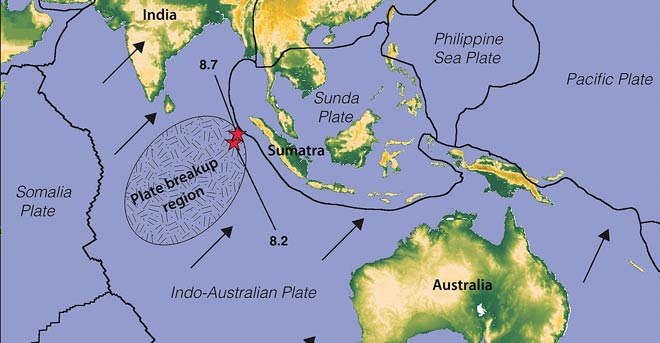
Ominous change in the South Pacific: The Santa Cruz seismic swarms are unfolding against an even more complex geological backdrop. Consequently, the effects of this massive seismic upheaval signals ominous change for the entire Pacific basin. To the west, the Indo-Australian plate is breaking up after the largest strike-slip earthquake struck the off the coast of Indonesia in April of 2012. The Solomon Sea Plate, to the east, is an oceanic crustal plate remnant, which is disappearing into two subduction zones, one to its north, the other on its southwest margin. Its southeast margin runs along the Woodlark Rise, undefined compressive zone, which may be a transform fault marking the boundary with the adjoining Woodlark Plate. The northern subduction zone is located where the Solomon Plate is diving below the South Bismarck Plate to the northwest and the Pacific Plate to the northeast. The northwest part of the subduction zone is called the New Britain Subduction Zone. New Britain in Papua New Guinea is the volcanic island formed from this collision and resulting volcanism. The southwestern subduction zone is where the Solomon Pate is diving below the Indo-Australian Plate. According to scientists, the Indo-Australian plate may in the process of breaking up and this heightened activity around the Santa Cruz Islands is placing addition pressures on a plate already in trouble. We should continue to watch the region of Indonesia for massive changes to come, including very large-scale volcanic eruptions. Nearly all of the planet’s current 15 tectonic plates, and in some cases, sub-plates and volcanic arcs are heavily stressed by the recent violent mobility of tectonic plates shaken by earthquakes. I’ve never quite seen a pattern this fraught with danger or as heavily laden with seismic tension. The planet is now experiencing a major geological crisis, and it’s showing some indication of worsening. –The Extinction Protocol
Film director Brian De Palma has become an expert in voicing people's frustration with the shortcomings of the US government. RT caught up with the celebrated Hollywood filmmaker and screenwriter to ask him political and apolitical questions. READ MORE: http://on.rt.com/7v1ch7
Protests turn violent in key Egyptian cities again on Friday, as thousands take to the streets to demand the end of Morsi’s government. Petrol bomb-throwing protesters clash with the police in front of the presidential palace in Cairo.
Protesters threw Molotov cocktails and stones at the British Embassy in Cairo and clashed with the security guards, Al-Arabiya reported.
Cairo footage also showed angry crowds pushed back from the presidential palace by the police.
Egypt’s presidential office has called political factions to withdraw from outside the president’s palace, Al-Arabiya said. Egyptian PM Hesham Qandil has also urged all political parties to condemn violent protesters.
But the opposition is unlikely to call the people off the streets after it spoke in favor of mass demonstrations despite Thursday talks with Sheikh Ahmed Al-Tayyeb of Al-Azhar University. Al-Tayyeb, a well-respected spiritual figure in Egypt, urged the rival sides to renounce violence and agree to set up a committee to start peaceful talks. “The marches for tomorrow are still on, as the Azhar document condemns violence but we are not doing anything violent,” one of the opposition members was cited by Reuters.
Chaos and violence will continue if Morsi ignores the peoples’ demands, the opposition leader Mohamed ElBaradei said on Friday according to Al-Arabiya. Egypt’s National Salvation Front will meet Saturday to discuss the latest developments, Al-Arabiya added.
Sporadic clashes with the police in Cairo were also reported earlier Friday, and several protesters were injured by rubber bullets.
Several thousand people have gathered in Tahrir square on Friday, RT’s Bel Trew said. “We came here to get rid of Morsi. He's only a president for the Brotherhood,” a protester told Reuters from amid the angry crowd that filled Tahrir square.
Read More: Violence flares in Cairo as thousands protest Morsi regime throughout Egypt — RT
Egyptian protesters throw projectiles in front of the presidential palace in Cairo on February 1, 2013.(AFP Photo / Khaled Desouki)
A truck laden with fireworks exploded on an elevated highway in central China, killing at least nine people and injuring 13. The force of the blast sent several vehicles plummeting off the road, destroying an 80-meter section of the highway.
Salvage teams are currently at the scene of the incident on the G30 expressway in China’s Henan province. The blast took place at 8:52am local time (00:52 GMT), Chinese state news outlet Xinhua reported, citing local officials.
The massive explosion threw six vehicles into a ravine 30 meters below the raised highway; the survivors were retrieved by emergency teams.
Accidents involving fireworks are relatively commonplace in China around the run up to the Chinese New Year, which will take place on February 10. Enormous quantities of fireworks are transported throughout China, often under unsafe conditions to meet public demand in preparation for the public holiday.
The Ministry of Public Security dispatched a team to the site of the explosion to establish the cause of the blast, Xinhua reported.
In 2006, a fireworks storeroom exploded in Henan province, killing 36 people.
Read More: Chinese highway collapses after fireworks truck explodes, 9 killed (PHOTOS, VIDEO) — RT
A suicide bomber has attacked the US Embassy in Ankara. At least one security guard working at the embassy was killed in the blast, as well as the bomber.
The blast occurred at the entrance used by the embassy personnel and their visitors, CNNTurk reported. A security guard operating at the x-ray machine at the entrance was reportedly killed while the suicide bomber was passing through the scanner.
"There were two dead in the suicide bombing, a Turkish security guard and the bomber himself," Ankara governor Alaattin Yuksel told reporters, AFP reports.
The US ambassador to Turkey, Francis Ricciardone, confirmed the death. "We are very sad of course, we lost one of our Turkish guards at the gate… The compound is secure, we all feel very safe thanks to your response," he told reporters.
Read More: Suicide bomber strikes US Embassy in Ankara, two killed — RT