
Friday, June 21, 2013


Million-strong anti-govt protests sweep Brazil, 1 killed - YouTube
Wednesday, June 19, 2013
Turkey using chemical laden water canons on protestors: Chemical Shower: Turkish cannons 'cause skin burns & insomnia'
The Turkish police crackdown has been widely condemned for its violent intensity - even riot control methods are not quite what they seem, as Irina Galushko reports. READ MORE: http://on.rt.com/2dow77
Saturday, June 15, 2013
Deja Vu all over again: Another WMD threat cited to invade and destroy another Sovereign Nation!
Russian Foreign Minister Sergey Lavrov has insisted there is no sense in the Syrian regime using chemical weapons against the rebels, an accusation thrown at the leadership by the international community.
"The government, as the opposition is saying openly, is enjoying military success on the ground," Lavrov indicated to reporters during a joint press conference with his Italian counterpart Emma Bonino.
"The regime isn’t driven to the wall. What sense is there for the regime to use chemical arms – especially in such small amounts?" Lavrov asked adding that the data provided by the US showed that 100 to 150 people suffered from the alleged chemical attacks.
Lavrov underlined that any rumors of chemical weapons deployment concern Russia, and Moscow always seeks to check and recheck them.
On June 13, the US stated it assessed that chemical weapons, most likely the nerve gas sarin, were used in battle against the Syrian rebels. The Russian Foreign Ministry confirmed Friday the assessment results had been handed over to them, but it found them “fabricated” and “unconvincing”.
Following the chemical weapons statement the US authorized to release of at least some US arms for Syria’s rebels as part of new military and political aid measures, sources told Reuters.
Commenting on that on Saturday, Lavrov pointed out it would be wrong for the US administration "to be sending wrong signals" to the opposition and “focus them on escalating the fight instead of starting a dialogue.”
US diplomats have also told media that Washington is now considering a no-fly zone “to help Assad's opponents.” The speculation was fuelled by the US earlier reportedly sanctioning their F-16 fighter jets and Patriot anti-missile system to stay in Jordan past the expiration of the 12-day Eager Lion exercise currently underway.
Lavrov stressed that any attempt to enforce a no-fly zone over Syria using the F-16s and Patriots from neighboring Jordan would break international law.
"There have been leaks from Western media regarding the serious consideration to create a no-fly zone over Syria through the deployment of Patriot anti-aircraft missiles and F-16 jets in Jordan," Lavrov said.
"You don't have to be a great expert to understand that this will violate international law," he noted.
Jordanian officials confirmed earlier this month that the US would be deploying the weaponry during the exercises, but a source speaking to AFP now says those items will stay overseas indefinitely.
The latest rhetoric comes ahead of the so-called Geneva 2 talks aimed at getting the two warring sides at the negotiating table for the first time.
The Syrian civil conflict has lasted for over two years, and left over 80,000 people dead, according to UN estimates.
The latest rhetoric comes ahead of the so-called Geneva 2 talks aimed at getting the two warring sides at the negotiating table for the first time.
The Syrian civil conflict has lasted for over two years, and left over 80,000 people dead, according to UN estimates.
Friday, June 14, 2013
The US-NATO War / Killing Machine to openly destroy Syria: US to give military support to Syrian rebels as ‘red line' crossed
Editor's Note: Democracy is coming to Syria as it has in Afghanistan, Pakistan, Iraq, and Libya. Given the history of the US war machines since the early 20th century in which time it has destroyed dozens of nations, killed tens of millions of people overtly, and participated in the killing of hundreds of millions covertly, is it any surprise that another nation now finds itself in American cross-hairs? All in the name of FREEDOM & DEMOCRACY - what hypocrisy! Though the US may be the hammer of the whole earth, as Assyria was, as Babylon was, as were Persia, Greece and Rome, powers that make victims out of multitudes of nations and peoples eventually find themselves to be the victims of those in whose slaughter they participated. God's wrath is sure to fall upon Amerika Babylon - the only question that remains to be answered is when will it happen?
__________________________________________________________________________________
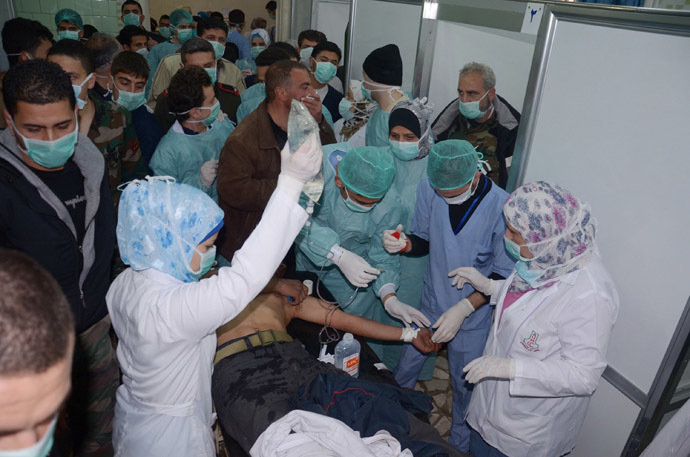
After concluding that the Syrian government has used chemical weapons against the country's insurgency, thus crossing a ‘red line,’ the Obama administration has decided to start sending arms to anti-Assad rebels for the first time, officials say.
The Obama administration has assessed that chemical weapons, most likely the nerve gas sarin, were used in battle against the Syrian rebels, Deputy National Security Adviser for Strategic Communications Ben Rhodes said in a statement.
The “intelligence community assesses that the Assad regime has used chemical weapons on a small scale against the opposition multiple times in the last year,” he said.
The Syrian Foreign Ministry branded the US statements on the use of chemical weapons a “caravan of lies”.
"The United States, in resorting to a shameful use of pretexts in order allow President Obama's decision to arm the Syrian opposition, shows that it has flagrant double standards in the way it deals with terrorism," it said.
Syria had insisted in the past that it did not use its chemical arsenal in the ongoing conflict and would not do so unless invaded by a foreign nation.
President Obama has authorized to release of at least some US arms for Syria’s rebels as part of new military and political aid measures, according to a source who spoke with Reuters.

Read More: US to give military support to Syrian rebels as ‘red line' crossed — RT News
Thursday, June 13, 2013
Who's behind the Turkish Spring? Barricades and chants in response to Turkish PM’s 24-hour deadline
Editor's Note: Revolution is being fomented in Turkey, much as it has been in Libya and Syria. It seems that the same powers that destroyed Libya (and Iraq and Afghanistan and Pakistan), and are in the process of destroying Syria, are spreading their reach to Turkey. The question is where does it all end? I think it will end one day in the near future but not till the whole world is lying in ruins. The Apocalypse is upon us - believe it or not!
________________________________________________________________________________
Turkish protesters remain defiant after Prime Minister Tayyip Erdogan declared that the disturbances must end within 24 hours. Overnight riot police used tear gas and water cannons to break up activists in Ankara as they built barricades.
“I have given orders to the interior minister,” Erdogan said Wednesday. “This will be over in 24 hours.”
He added that the protests were hurting Turkey’s image and economy. Meanwhile, Turkey’s Ruling Justice and Development Party (AK Party) Deputy Chairman Huseyin Celik has said a referendum might be held to decide whether to build replicas of Ottoman-era barracks in Gezi Park or leave it as it is.
Erdogan’s deadline is unlikely to be observed by the protesters, reports RT’s Irina Galushko from Istanbul. Following PM’s statements, activists at Taksim Square were chanting and singing in defiance of his order to leave.
The city was relatively quiet overnight, but the capital Ankara saw its fifth night of rioting in a row. There police again used tear gas and water cannons to break up some 2,500 protesters, as they were trying to erect barricades on a road leading to government offices.

Tuesday, June 4, 2013
EARTH IN DECLINE EXTREME WEATHER EVENTS MAY 2013
PART 2
Monday, June 3, 2013
Powerhouse Fire: Three wildfires sweep Los Angeles and New Mexico, burning tens of thousands of acres | Mail Online
Hell on earth: California wildfire TRIPLES in size by Sunday night with 22,400 acres now ablaze as thousands flee their homes
- Powerhouse Fire in California's Angeles National Forest grew to 22,400 acres by Sunday night and threatens 1,000 homes
- Tres Lagunas Fire in Santa Fe National Forest in New Mexico has spread to 7,000 acres
- Thompson Ridge Fire in nearby Valles Caldera National Preserve spread to 1,200 acres
- At least six homes destroyed and three firefighters injured in Los Angeles blaze
- High winds, record high temperatures, low humidity has turned dry ground brush into a tinderbox

Sunday, June 2, 2013
Fear mogering WHO back at it again with SARS, Bird Flu, Coronavirus and other threats designed to create a medical Police State!
Editor's Note: Since the 90's, the WORLD HEALTH ORGANIZATION, which should more appropriately be called WORLD DISEASE ORGANIZATION has been fear mongering about coming pandemics that will wipe out humanity. There is no doubt that a Pandemic or Pandemics will kill significant numbers of humans in the near future. But the purpose of such fear mongering by the WHO and other Health (Sickness) Agencies of various governments is to exercise near total control over us in the name of a medical emergency. And the fact that it is these very same governments that are busy creating these deadly diseases in laboratories will never be revealed by the WHO. When the next pandemic comes, I would be much more weary of the CURE that will offered by the WHO and others, most likely some sort of vaccine, that will likely kill far more people than any disease. The 1918 misnomered Spanish Flu was engineered, so will the next killer pandemic.
_____________________________________________________________________________
 June 1, 2013 – MIDDLE EAST – Five additional cases of coronavirus, initially named nCoV, has been confirmed in Saudi Arabia, according to the country’s Ministry of Health. The Ministry reported the new cases to the World Health Organization (WHO) on Wednesday. Three of the patients have died, as well as a fourth patient — an 81-year-old woman — who was earlier reported to be infected with the virus. All five new patients were from the eastern region of the country, but not from Al-Ahsa, where an April 2013 outbreak occurred in a healthcare facility. The Saudi government is now investigating the likely source of infection in both the healthcare and community settings, according to the WHO. The Ministry said all five patients had underlying medical conditions which resulted in multiple hospitalizations. The first patient, a 56-year-old man, became ill on May 12 and died on May 20. The second patient is an 85-year-old woman who became ill on May 17 and is currently listed in critical condition. The third patient was a 76-year-old woman who became ill on May 17 and was released from the hospital on May 27. The fourth patient was a 77-year-old man who became ill on May 19 and died on May 26. The fifth patient, a 73-year-old man, became ill on May 18 and died on May 26. The new cases now bring the total number of infected persons to 50, according to the NY Daily News. The three latest deaths also bring the coronavirus-related death count to 30, increasing the mortality rate to 60 percent. In a report released on May 28, the WHO issued recommendations for “enhanced surveillance and precautions for the testing and management of suspected cases.” It said it would also continue to work with international partners for as long as needed. The novel coronavirus was redubbed on May 23 following a proposal by the Coronavirus Study Group of the International Committee on Taxonomy of Viruses (ICTV). It recommended the virus be called the Middle East Respiratory Syndrome Coronavirus (MERS-CoV). The WHO said it generally prefers that viruses are not named after regions or places from where they are initially detected in order to minimize unnecessary geographical discrimination that may be based on coincidental detection rather than a true area for emergence of the virus. The WHO said no group was convened to discuss the naming of the virus, but noted that the proposed name does represent a consensus that is acceptable to the organization, since it was “built on consultation with a large group of scientists.” Although the WHO continues to work closely with countries and international partners, it currently is not advising special screenings pertaining to the virus and it has offered no recommendations on travel or trade restrictions. It said it will continue to closely monitor the situation. But as experts continue to look into cases and deaths pertaining to MERS-CoV, it becomes clear that some level of precaution is needed to ensure the virus is contained. Health experts are calling on healthcare facilities to isolate patients who show signs and symptoms of MERS-CoV for at least 12 days to avoid spreading it to other patients and/or relatives. French health officials recently reported the first death in their country of a man who became ill last month after visiting the Middle East; he spread the infection to a hospital patient who shared a room with him. That second man remains in serious condition, according to the French Health Ministry. Experts are currently unsure how the first cases of the virus infected humans, but believe it came from animals such as bats, camels or goats. Since taking a stronghold, the virus has shown some level of transmissibility between humans, but health officials are stopping short of saying it is highly contagious until more information is on the table. In a speech on Monday, WHO’s Director-General, Dr. Margaret Chan, said the MERS-CoV is currently the greatest concern for her organization, calling the ongoing crisis a “threat to the entire world.” Maria Cheng of The Associated Press reported yesterday that French doctors have estimated the incubation period for the disease is between nine and 12 days, longer than an original estimate of between seven and 10 days, reported by other officials. This new estimation is why the experts are calling for longer quarantines, especially since those with underlying medical conditions are very susceptible from exposure to infected persons. In a paper published in The Lancet, the French experts wrote that if the virus further evolves, it could become significantly more dangerous. Further mutations could mean the virus becomes “increasingly transmissible.” –Red Orbit
Virus spreads to Italy: Italy reported its first case of the SARS-like coronavirus on Friday, a 45-year-old man who had been travelling in Jordan, the health ministry said. The patient was in good condition and was being monitored in isolation, the ministry said in a statement. He was admitted to a hospital in Tuscany with a high fever, a cough and breathing difficulties. A resident of Italy with foreign nationality, the man recently spent 40 days in Jordan where one of his sons was suffering from an unspecified flu. Saudi Arabia has been the most affected by the virus, with 39 cases and 25 deaths so far, according to data from the World Health Organization. The virus, which can cause coughing, fever and pneumonia, has spread from the Gulf to France, Britain and Germany. The WHO has called it the Middle East Respiratory Syndrome Coronavirus (MERS-CoV). It is from the same viral family that triggered the outbreak of Severe Acute Respiratory Syndrome (SARS) that swept the world in late 2003 and killed 775 people. –Reuters
Is Turkey next in line for an Arab Spring? Protesters defiant, as unrest in Turkey enters third day
 June 2, 2013 – TURKEY – Protesters
lit fires and scuffled with police in parts of Istanbul and Ankara
early on Sunday, but the streets were generally quieter after two days
of Turkey’s fiercest anti-government demonstrations for years. Hundreds
of protesters set fires in the Tunali district of the capital Ankara,
while riot police fired tear gas and pepper spray to hold back groups of
stone-throwing youths near Prime Minister Tayyip Erdogan’s office in
Istanbul. Istanbul’s central Taksim Square, where the protests have been
focused, was quieter after riot police pulled back their armored trucks
late on Saturday. Demonstrators lit bonfires among overturned vehicles,
broken glass and rocks and played cat-and-mouse on side streets with
riot police, who fired occasional volleys of tear gas. The unrest was
triggered by protests against government plans to build a replica
Ottoman-era barracks to house shops or apartments in Taksim, long a
venue for political protest. But it has widened into a broader show of
defiance against Erdogan and his Islamist-rooted Justice and Development
Party (AKP). Interior Minister Muammer Guler said on Saturday that 939
people had been arrested in more than 90 separate demonstrations around
the country. More than 1,000 people have been injured in Istanbul and
several hundred more in Ankara, according to medics. The ferocity of the
police response has shocked Turks, as well as tourists caught up in the
unrest in one of the world’s most visited destinations. It has drawn
rebukes from the United States, European Union and international rights
groups. Helicopters have fired tear gas canisters into residential
neighborhoods and police have used tear gas to try to smoke people out
of buildings. Footage on YouTube showed one protester being hit by an
armored police truck as it charged a barricade. “All dictators use the
same methods, oppressing their people,” said Mehmet Haspinar, a
60-year-old retired government employee sheltering in a building
entrance way as riot police fired pepper spray in an Ankara back street.
Erdogan has overseen a transformation in Turkey during his decade in
power, turning its once crisis-prone economy into the fastest-growing in
Europe. He remains by far the country’s most popular politician, but
critics point to what they see as his authoritarianism and religiously
conservative meddling in private lives in the secular republic. Some
accuse him of behaving like a modern-day sultan. Tighter restrictions on
alcohol sales and warnings against public displays of affection in
recent weeks have provoked protests. Concern that government policy is
allowing Turkey to be dragged into the conflict in neighboring Syria by
the West has also led to peaceful demonstrations. “It’s about democracy,
and it’s going to get bigger,” said one demonstrator in a side street
off Taksim Square, trying to rinse tear gas from his eyes. Erdogan has
called for an immediate end to the protests and has said his government
will investigate claims that the police have used excessive force. But
he remained defiant. “If this is about holding meetings, if this is a
social movement, where they gather 20, I will get up and gather 200,000
people. Where they gather 100,000, I will bring together one million
from my party,” he said in a televised speech. –Reuters
Friday, May 31, 2013
USA Watchdog War & Finance News: Syria & Russian Missiles, France & New Zealand Trade with China in Yuan, Stock Market Records & More
Published on May 30, 2013
http://usawatchdog.com/weekly-news-wr... - In Syria, the Assad regime wants high-tech Russian missiles to thwart new efforts for a no-fly zone that the Obama Administration may be calling for. Israel says if the Russians deliver them, they will attack and knock them out. Embattled Attorney General Eric Holder has invited many mainstream media organizations for an "off-the-record" conversation, and most outlets have declined to allow the White House to engage in spin and pressure to get the media back in line. The stock market is in record territory. The mainstream media (MSM) says the Bull Run is on "solid footing." The MSM always fails to mention all the QE, or money printing, by the Fed in the last few years. Join Greg Hunter of USAWatchdog.com as he gives his analysis on these stories and more in the Weekly News Wrap-Up.
New SARS Virus Threatens Entire World? - plus other health news!
Published on May 31, 2013
Geneva, Switzerland (Reuters via CCTV) - The novel coronavirus has become a threat to the entire world, said the general director of WHO at the World Health Assembly 2013 in Geneva Monday.The novel coronavirus was first recognized in March 2012 in the Middle East area. It has been watched worldwide because the virus belongs to the same family with SARS and has a 50 percent fatality rate.
At the World Health Assembly 2013 on Monday, Dr. Margaret Chan, the Director-General of WHO showed special concern about the spread of novel coronavirus. She said this virus caused the world to take action because WHO has not confirmed the origin of this virus or how it transmits.
"Looking at the overall global situation, my greatest concern right now is the novel coronavirus. We understand too little about this virus when viewed against the magnitude of its potential threat. The novel coronavirus is not a problem that any single affected country can keep to itself or manage all by itself. The novel coronavirus is a threat to the entire world," said Dr. Chan.
Novel coronavirus was renamed Middle East Respiratory Syndrome Coronavirus (MERS-CoV). WHO said that several Middle East countries have been affected by this significant public health threat, including Jordan, Qatar, Saudi Arabia, and the United Arab Emirates, and cases with direct or indirect connection to the Middle East have also been reported by France, Germany, Britain and Tunisia.
By May 29, according to WHO, the global total of confirmed cases of human infections with MERS-CoV reached 49, including 27 deaths. http://www.solarnews.ph/lifestyle/hea...
http://www.infowars.com/bilderberg
or
http://www.infowars.com/b
Wednesday, May 29, 2013
Russia - US in war of words over Syria: Russia blasts US double standards over Syrian peace progress — RT News
The US-Russian initiative for a comprehensive peace conference to resolve the Syrian crisis needs honest effort of those involved. But some nations apparently try to undermine the effort to call the meeting, says the Russia’s foreign minister.
The criticism by Russian Foreign Minister Sergey Lavrov was voiced as he commented on a draft resolution currently discussed at the UN Human Rights Council. The document sponsored by Qatar and Turkey seeks to condemn the Syrian government for the alleged use of mercenaries against rebel forces. The ‘mercenaries’ in question are from the Lebanese militant movement Hezbollah, who are fighting in Syria.
“To my great astonishment we have learned that in addition to the sponsors of this draft resolution the US delegation is promoting most vigorously this very unhelpful idea. I asked [US State Secretary] John Kerry about it in Paris, and apparently he was not aware of this situation. He promised to handle it, but I don’t know whether he managed to do it,” Lavrov said.
He added that Russia currently sees no alternative to the peace conference, which would hopefully gather all interested parties, including the Syrian government, various Syrian opposition groups, regional powers like Iran and other. But doing it requires a genuine joint effort.
“We need everyone to work honestly and not allow double standards – backing the conference in statements and taking steps actually aimed at undermining this suggestion in practice,” Lavrov explained.
Lavrov also explained that the primary focus of Hezbollah fighters in Syria as stated by the leadership is the protection of the Shia population and holy sites from the threat posed by Sunni rebel forces. He said it indicates that the Syrian conflict is increasingly characterized by sectarian confrontation, a development which Russia has long warned against.
 Russia and the US have diverged in their position over the end of EU’s embargo on delivery of arms to Syria this week, which may open the door for direct arming of rebel groups by European nations. Washington praised the development, saying it gives Europe more flexibility and ramps up pressure on Syrian President Bashar Assad.
Moscow sees it as not only counterproductive, but also potentially unlawful, since delivering arms to non-governmental actors against the wishes of a country’s government breaks international law. Such moves are forbidden both by UN-level treaties on arms trade and EU’s own guidelines.
Russia itself has standing military contracts with the Syrian government, which it intends to fulfill. Supporters of the rebels, including the US, have criticized Russia on several occasions over arming the Assad army. Moscow insists that the weapon systems it sold Syria cannot be used against the rebels.
For example the S-300 surface-to-air missiles are meant to shoot down aircraft and some ballistic missiles, neither of which the rebels have. Russia believes that its position helps stabilize the situation and restrain external parties, which would like to use force in Syria.
The criticism by Russian Foreign Minister Sergey Lavrov was voiced as he commented on a draft resolution currently discussed at the UN Human Rights Council. The document sponsored by Qatar and Turkey seeks to condemn the Syrian government for the alleged use of mercenaries against rebel forces. The ‘mercenaries’ in question are from the Lebanese militant movement Hezbollah, who are fighting in Syria.
“To my great astonishment we have learned that in addition to the sponsors of this draft resolution the US delegation is promoting most vigorously this very unhelpful idea. I asked [US State Secretary] John Kerry about it in Paris, and apparently he was not aware of this situation. He promised to handle it, but I don’t know whether he managed to do it,” Lavrov said.
He added that Russia currently sees no alternative to the peace conference, which would hopefully gather all interested parties, including the Syrian government, various Syrian opposition groups, regional powers like Iran and other. But doing it requires a genuine joint effort.
“We need everyone to work honestly and not allow double standards – backing the conference in statements and taking steps actually aimed at undermining this suggestion in practice,” Lavrov explained.
Lavrov also explained that the primary focus of Hezbollah fighters in Syria as stated by the leadership is the protection of the Shia population and holy sites from the threat posed by Sunni rebel forces. He said it indicates that the Syrian conflict is increasingly characterized by sectarian confrontation, a development which Russia has long warned against.
Free Syrian Army fighters lay cover fire after what they say was during clashes with forces loyal to President Bashar al-Assad in Deir al-Zor May 13, 2013. (Reuters)
Moscow sees it as not only counterproductive, but also potentially unlawful, since delivering arms to non-governmental actors against the wishes of a country’s government breaks international law. Such moves are forbidden both by UN-level treaties on arms trade and EU’s own guidelines.
Russia itself has standing military contracts with the Syrian government, which it intends to fulfill. Supporters of the rebels, including the US, have criticized Russia on several occasions over arming the Assad army. Moscow insists that the weapon systems it sold Syria cannot be used against the rebels.
For example the S-300 surface-to-air missiles are meant to shoot down aircraft and some ballistic missiles, neither of which the rebels have. Russia believes that its position helps stabilize the situation and restrain external parties, which would like to use force in Syria.
Tuesday, May 28, 2013
World War 3 looming as Russia ups the ante in Syrian conflict? Russia slams end of EU arms embargo, calls S-300s ‘stabilizing factor’ in Syria
The failure of the European Union to agree on a new arms embargo for Syria is undermining the peace process, Moscow says. But the delivery of S-300 surface-to-air missiles may help restrain warmongers.
The comments come from Deputy Russian Foreign Minister Sergey Ryabkov, referring to the results of Monday’s meeting in Brussels. After a lengthy negotiating session, EU governments failed to resolve their differences and allowed a ban on arming the Syrian opposition to expire, with France and Britain scoring an apparent victory at the expense of EU unity.
The EU's move, which the Russian diplomat branded as an "example of double standards", opens the door for Britain and France to supply weapons to Syrian rebels fighting the regime of President Bashar Assad.
Criticizing Europe’s decision to open the way for potential arms shipments to Syrian rebels, Russia insists that its own sale of arms to the Syrian government helps the international effort to end the two-year-long conflict, the diplomat added. He was referring to the delivery of the advanced S-300 long-range air defense systems, which Russia is carrying out under a contract signed with Syria several years ago.

“Those systems by definition cannot be used by militant groups on the battlefield,” Ryabkov said. “We consider this delivery a factor of stabilization. We believe that moves like this one to a great degree restrain some hotheads from escalating the conflict to the international scale, from involving external forces.”
However, Russia has neither confirmed, nor denied “the status of those shipments.”
“The only thing I can tell is that we are not refusing from them,” Sergey Ryabkov said. “We see that this question worries our partners, but we have no reason to reconsider our position in this sphere,” he said.
Despite the uncertainty around S-300 shipments, Israel said it will know how to act if Russia does supply surface-to-air missiles.
"I can say that the shipments are not on their way yet," Defense Minister Moshe Yaalon told reporters. "I hope they will not leave, and if, God forbid, they reach Syria, we will know what to do," he said, without disclosing his sources.
Israel is concerned by possible Russian supplies to Syria, saying that advanced weapon systems could end up in the hands of Iran or the Lebanese Hezbollah group.
Once the Russian SAM missiles are deployed by Syria, it will have a better control of its airspace. The country endured three airstrikes this year, which are widely thought to have been conducted by Israel, but were never officially confirmed as such.
Britain and France have made a commitment not to deliver arms to the Syrian opposition "at this stage," an EU declaration said. EU officials, however, said the commitment effectively expires on August 1.
UK Foreign Secretary William Hague has defended the lifting of the EU’s embargo, saying that Britain would only send arms to Syrian rebels with other countries. At the same time he assured that this would not violate international law.
London and Paris have argued support for rebels fighting Assad by allowing EU arms deliveries, despite the fact that extremist elements are known to work alongside the rebels.
Other EU governments, led by Austria and Sweden, argued that sending more weapons to the region would increase violence and spread instability.

Russia's envoy to NATO Aleksandr Grushko said that the abolition of the EU arms embargo on the Syrian opposition will only exacerbate armed conflict in that country.
"We need to refrain from taking steps that would be contrary to this logic. Such steps include armed or non-lethal support to the opposition. This just adds fuel to the fire," Grushko said on Tuesday.
Meanwhile, Moscow and Washington remain undecided as to the content of a proposed international conference on Syria, according to Deputy Foreign Minister Sergey Ryabkov.
"There remains a gap between the positions of Russia and the US regarding some issues and aspects of this major international crisis," he emphasized.
"And we, for our part, cannot agree to hold such events [the international conference on Syria] amid a situation where partners and possible participants in such a conference seek to impose solutions on the Syrian people from the outside, as well as predetermine the course of a transitional process, the parameters of which have not been determined yet," Ryabkov said.
S-300 anti-aircraft missile system. (RIA Novosti / Vladislav Belogrud)
The S-300 is a series of Russian long-range surface-to-air missile systems designed to intercept ballistic missiles, regarded as the most potent weaponry of its class. The missiles are capable of engaging aerial targets as far away as 200km, depending on the version used.
United Kingdom Secretary of State for Foreign and Commenwealth Affairs William Hague (L) speaks with Luxembourg Foreign Affairs minister Jean Asselborn (C) and Austrian Foreign minister Michael Spindelegger (R) prior to a Foreign Affairs Council on May 27, 2013, at the European Union headquarters in Brussels. (AFP Photo / Georges Gobet)
Sunday, May 26, 2013
Possible Pandemic Outbreak Soon? New H7N9 bird flu may be capable of human to human spread
New H7N9 bird flu may be capable of human to human spread | The Extinction Protocol: 2012 and beyond
May 25, 2013 – HEALTH – The new H7N9 bird flu virus can be transmitted between mammals not only via direct contact but also in airborne droplets, and may be capable of spreading from person to person, Chinese and American researchers have found. A study published in the journal Science and presented at a briefing in Hong Kong on Friday found that three ferrets – an animal often used for research on flu – that were in the same cage as ferrets infected with H7N9 had contracted the disease. One of three ferrets kept in separate cages nearby also became infected, through airborne exposure. The World Health Organization (WHO) has previously said it has no evidence of “sustained human to human transmission” of the virus, which has killed 36 people in China. “The findings suggest that the possibility of this virus evolving further to form the basis of a future pandemic threat cannot be excluded,” said the research team, led by bird flu expert and microbiologist Yi Guan. The virus can also infect pigs, but could not be transmitted from pig to pig or from pigs to other animals, the study showed, although the team urged authorities to maintain surveillance to check whether the virus was mutating. The WHO said the findings were useful but warned that people “have to be very careful about what’s going on the ground. Studies like that are really helpful for increasing general knowledge and it’s really helpful to know that, under lab conditions, this thing could transfer from person to person,” WHO chief spokesman Gregory Hartl told Reuters. “We’ve already seen maybe a few limited instances of human to human transmission within close family range, within close contacts, so this is another piece of the puzzle,” he said. The findings come just days after the WHO said the H7N9 virus appeared to have been brought under control in China thanks to restrictions at bird markets. H7N9 has relatively mild clinical signs in ferrets, according to the study. All the animals infected with the virus in the experiments presented symptoms for no more than seven days and all recovered from the disease. The researchers said that all cases where humans had died or become extremely ill had involved additional factors. The team also found that some infected animals did not develop fever or other clinical signs, suggesting that asymptomatic infections among humans may also be possible. “The potential public health implication of this … is that a person infected by H7N9 avian influenza virus who does not show symptoms could nevertheless spread the virus to others,” the researchers wrote in their study. “It is possible that this virus can evolve further to form the basis of a future pandemic threat,” said Maria Zhu Huachen, an assistant professor of research at HKU’s school of public health. United Nations experts said this week the bird flu outbreak in China had caused some $6.5 billion in losses to the economy. The H7N9 virus is known to have infected 131 people in mainland China and one in Taiwan since February, but no new cases have been detected since early May. –Reuters
Friday, May 24, 2013
Mega Earthquakes in diverse pla ces: Tremors felt in Moscow as 8.2 quake rattles Russia's Sakhalin region
Luke 21:11 And great earthquakes shall be in divers places, and famines, and pestilences; and fearful sights and great signs shall there be from heaven.
Published time: May 24, 2013 06:32 Edited time: May 24, 2013 09:42

Muscovites fled their offices after feeling the tremors that followed an earthquake in the Okhotsk Sea, thousands of kilometers away (image by @nakedarizona)
The residents informed security services of vibration and tremors that caused furniture and kitchen utensils to move.
The magnitude of the tremors felt in Moscow was no higher than 1 on the Richter scale, the Agency of Hydrometeorological and Environmental monitoring indicated.
Moscow residents wrote on Twitter about the tremors: “wasn’t really strong, but things hanging on the walls were shaking,” “the fourteenth floor of the Smolensky Passage [a large market in the city center] was noticeably shaking!” and “a house was shaking in the center of Moscow on Tverskaya street.”
“The aftershocks occurred in Nizhny Novgorod, Moscow, in Europe – for instance, in Romania. Almost the entire continent was shaken,” Anatoly Tsygankov, the head of the Situation Center for Agency of Hydrometeorological and Environmental monitoring told Interfax news agency.
An employee at news website NEWSru.com recounted the Moscow tremor: “I have a flat on the 7th floor. At 9:43am I was sitting at my desk in front of the computer when the desk started shaking. We have a metro station underground, so I thought that something happened there. But the vibrations continued, and it became clear that everything was shaking like during an earthquake." The witness says there were at least three tremors; two strong ones, and another, weaker one. Then he started calling Emergency. When the operator answered, the reporter heard someone telling another operator their address, and he understood that the vibrations were happening all over Moscow.
The scientists, however, are sure that there is nothing outstanding in the quake, but it's “deep – around 600 kilometers, in this situation tremors can be felt at long distances from the epicenter,” academic and scientist Alexander Soloviev explained.
Experts also pointed out that such a quake is unusual, although not impossible for the Russian capital: On March 4, 1977, Moscow was shaken by a 4.0-magnitude quake centered in the Carpathian Mountains.

The Kuril Islands environment (RIA Novosti / Sergey Krivosheyev)
Russia’s Emergency Ministry said that all of its departments are on high alert following the quake in the Okhotsk Sea.
“Our special attention is on the coastal area. The Ministry is going to watch out for the possible aftershocks. At the moment there’s absolutely no threat of tsunami, no buildings are destroyed, there are no injured and people are in no danger” Ministry representative Irina Rossius said.
Some Sakhalin region residents reported that they were unable to turn on electronic devices after the earthquake.
In the meantime, the seismic forecasters say that another quake with the magnitude of over 7 is expected to hit the Sakhalin region in the coming week.

Thursday, May 23, 2013
Austerity strikes in Italy: Millions of poverty-stricken Italians unable to afford heat, meat amid economic crisis
Published time: May 22, 2013 15:03
Edited time: May 22, 2013 15:45
Edited time: May 22, 2013 15:45

: Tourist pass by a street beggar in central Rome.(AFP Photo / Filippo Monteforte)
The data comes from national statistics institute ISTAT, which published an annual report demonstrating, among other issues, that Italy is witnessing youth unemployment of nearly 40 percent – the highest in Europe.
A reported 23.9 percent of young Italians are neither in the job market nor receiving education, the report stressed. In southern Italy, one in three young people aged 15-29 fell into this category.
Just over half (57.2 percent) of youths who graduated were currently employed, with the Europe-wide average standing at 77.2 per cent.
Fourteen percent of Italy’s population – 8.6 million people – is living on food assistance, a number that has doubled over the past two years, according to the report.
Nine poverty indicators were taken into account while carrying out the study; if a family meets more than four, it is considered to be seriously deprived. Some 15 million people – 25 percent of Italy’s population – are living in families that meet three or more of the poverty indicators, the research found.

Reuters / Stefano Rellandini
Over half of the Italian population is unable to afford a one-week vacation, including a staggering 69 percent of southern Italians, according to ISTAT.
The recession, which has now lasted almost two years, has taken a heavy toll on Italians, who are increasingly digging into their savings, ISTAT stressed. The savings rate, traditionally high in Italy, is currently far below that of France and Germany, Reuters reported.
Italians' purchasing power also fell by 4.8 percent last year, an "exceptionally steep" decline caused largely by aggressive tax hikes aimed at battling the economic crisis gripping the country.
The study results come just a few days after thousands gathered in Rome to protest austerity measures and high unemployment. Demonstrators urged Prime Minister Enrico Letta to create jobs to pull the country out of recession. Protesters held banners reading, “We can’t wait anymore” and “We need money to live.”
According to a Friday poll conducted by the SWG institute, the government’s approval rating has dropped to 34 percent, down from 43 percent at the start of May.

Students and protesters march in front of the Colosseum during a demonstration to protest against the cuts in the education budget and against the austerity measures in Europe on November 17, 2011 in Rome.(AFP Photo / Andreas Solaro)
Wednesday, May 22, 2013
Has a Global Pandemic begun? Tunisian man traveling to Saudi Arabia dies of coronavirus: scientists worried Hajj may touch off global pandemic
Matthew
24:7 For nation shall rise against nation, and kingdom against kingdom:
and there shall be famines, and pestilences (PANDEMICS, INFECTIOUS
DEADLY DISEASES), and earthquakes, in divers places.


The 2013 Hajj will take place in mid-October, only five months from now. Experts watching the coronavirus situation are already worried about the potential for spread of the new virus, both within Saudi Arabia and internationally. “I don’t think anyone necessarily knows for certain what is or isn’t happening,” said Dr. Kamran Khan, an infectious diseases specialist at St. Michael’s Hospital in Toronto.
May 21, 2013 – TUNIS, Tunisia – Tunisia’s Health Ministry says a 66-year-old man has died after being infected by the new coronavirus following a visit to Saudi Arabia. The ministry’s statement reported that his son and daughter were also diagnosed with the virus but have been treated and since recovered. The cases are the first for Tunisia and indicate that the virus is slowly trickling out of the Middle East, where more than 30 cases have been reported. There have been at least 20 deaths from the virus worldwide. The Tunisian, a diabetic, had been complaining since his return from a trip to Saudi Arabia and Qatar and died from acute respiratory distress at a hospital in Monastir. The new coronavirus is related to SARS, which killed about 800 people in 2003, mostly in Asia. –CTV News

WHO worried virus is spreading: The World Health Organization has issued a blunt assessment of the coronavirus outbreak in Saudi Arabia, acknowledging for the first time that there are concerns the virus may be spreading from person to person, at least in a limited way. The statement called for urgent investigations to find the source of the virus and learn how it is infecting people. And it reminded countries they have a duty to the international community to rapidly report cases and related information to the WHO. The worrying appraisal of the situation was echoed in a revised risk assessment issued Friday by the European Centre for Disease Control. It warned hospitals in Europe to be on the lookout for coronavirus cases coming in by air ambulance, saying the numbers of such patients may rise if the public in affected countries are afraid to seek care in their own hospitals. The warnings come as health leaders from around the world are gathering in Geneva for the World Health Assembly, the annual general meeting of the WHO. The eight-day meeting begins Monday. Though other nations have not publicly pressed leaders of coronavirus-affected countries for more transparency to date, it is likely that concerns about the virus and the opaque way investigations into it are being handled will be aired during the meeting. “There is no formal agenda for novel coronavirus but I would be surprised if it didn’t come up,” WHO spokesman Gregory Hartl said in an interview. Saudi Arabia, after all, is the home of Mecca. The holy site draws roughly three million Muslims from around the world every year to the Hajj, a mass pilgrimage Muslims are meant to perform at least once in their lifetimes. As well, nearly one million international tourists travel to Mecca during Ramadan — the Muslim month of fasting — to take part in another pilgrimage called Umrah. Ramadan starts in the second week of July this year. And the 2013 Hajj will take place in mid-October, only five months from now. Experts watching the coronavirus situation are already worried about the potential for spread of the new virus, both within Saudi Arabia and internationally. “I don’t think anyone necessarily knows for certain what is or isn’t happening,” said Dr. Kamran Khan, an infectious diseases specialist at St. Michael’s Hospital in Toronto. In his research, Khan tracks global travel patterns as a tool to predict and interpret spread of diseases. “I’m not sure that there’s an easy way to get at this information unless it’s more forthcoming from within Saudi Arabia or any of the partners that are working with Saudi Arabia inside the country.” To date, the WHO has been notified of 41 confirmed infections with the virus, which has been recently named MERS, for Middle Eastern respiratory syndrome coronavirus. Of those cases, 20 have been fatal. The bulk of the infections have occurred in Saudi Arabia, which is investigating a large and ongoing outbreak in the eastern part of the country, near the Persian Gulf. The most recent case — an 81-year-old woman whose illness was announced Saturday — is part of that outbreak. In its statement, the WHO said two of the cases in that outbreak have no links to either other coronavirus patients or a hospital where some transmission is known to have occurred. These unconnected cases suggest two possibilities. They could have contracted the virus from its as-yet unidentified reservoir, which is thought to be one or more animal species. Or these cases could be a signal that undetected human transmission is happening there. “The continued appearance of cases that are not part of larger clusters, and who do not have a history of animal contact, increases concerns about possible community transmission. This possibility is being investigated by authorities in Saudi Arabia,” the WHO statement said. –Ottawa Citizen
Subscribe to:
Posts (Atom)